1. The Crucible of Unity

The most significant historical achievement of Silla was the successful unification of the Three Kingdoms in 676 CE. This was not a simple military conquest, but a profound socio-political experiment. To maintain peace, the Silla court integrated the bureaucratic systems and intellectual elites of the conquered states into its own government.

This commitment to inclusivity—balancing central authority with regional stability—is the ancestor of the administrative efficiency and social cohesion seen in modern Korea. Gyeongju remains the witness to this monumental transition, marking the moment when a fragmented peninsula first conceived of itself as a unified nation.

A scenic view of Bulguksa Temple's main hall and Dabotap Pagoda, a masterpiece of Silla dynasty architecture in Gyeongju.

2. The Architectural Philosophy of “Infinite Stability”

The construction of Bulguksa Temple and the Seokguram Grotto in the 8th century represents the zenith of Silla’s intellectual ambition. These were not built as mere places of worship, but as structural embodiments of a utopian world.

The master builders faced a complex challenge: how to reconcile the permanence of stone with the fragility of human life. Through advanced mathematics, they created structures that have survived for over 1,200 years. For the observant visitor, these temples offer a look into the core of the Korean psyche—a deep-seated belief that with enough precision, discipline, and aesthetic harmony, human civilization can achieve a form of eternal stability.

The ancient Cheomseongdae observatory surrounded by vibrant crape myrtle trees in a peaceful park in Gyeongju.

3. A Sanctuary for the Modern Traveler

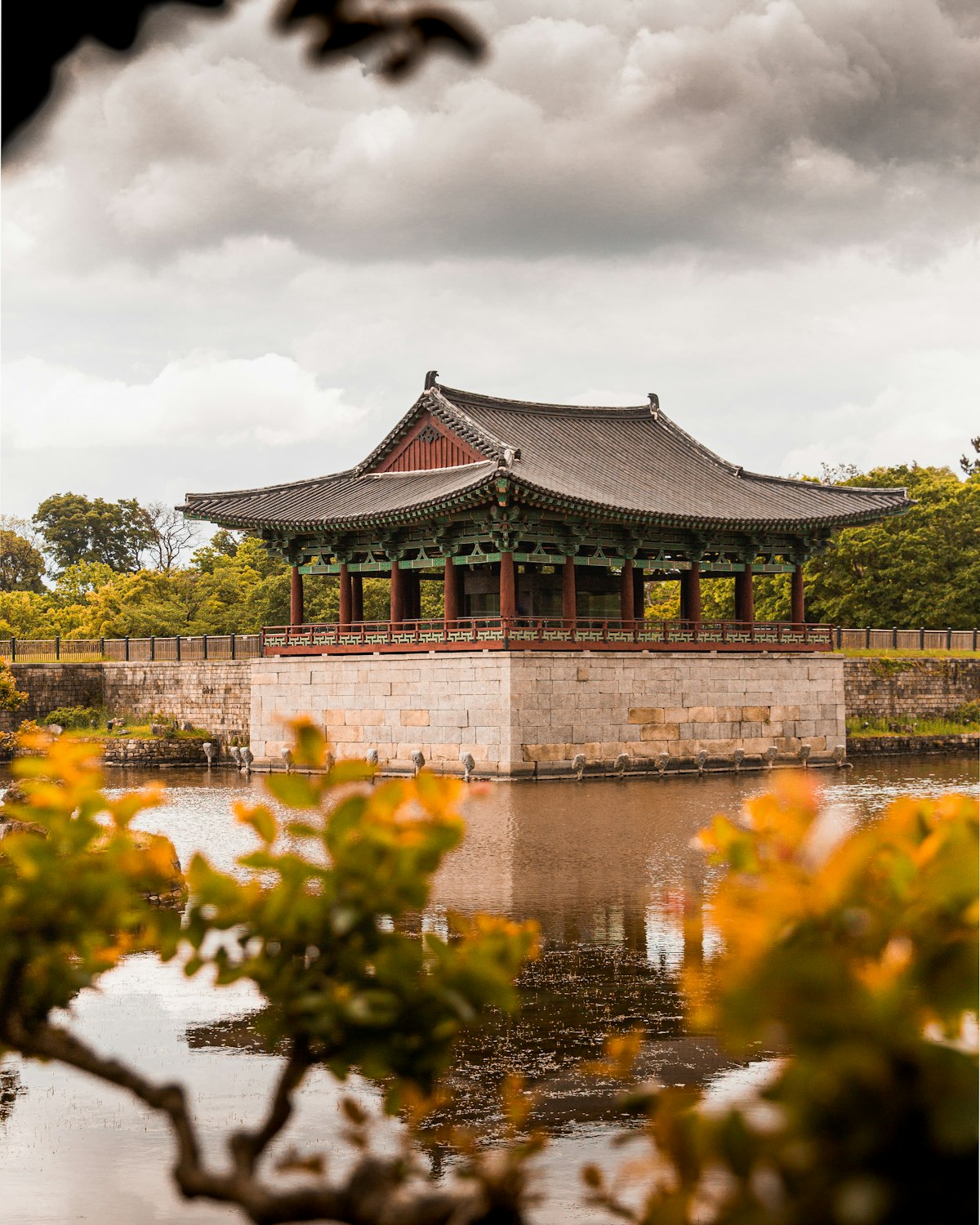
Beyond its historical weight, Gyeongju is a rare sanctuary for the modern traveler. While cities like Seoul pulse with constant motion, Gyeongju invites you to slow down. The city is often called an “open-air museum,” where ancient royal tombs rest as gentle, green hills in the heart of the city, surrounded by lotus ponds and quiet bike paths.

For those seeking a deeper connection, the “Temple Stay” program offers a profound experience: a night spent in the rhythm of temple life. Waking up to the sound of monastic chants, participating in tea ceremonies, and experiencing the meditative stillness of nature provides a rare contrast to the digital noise of the 21st century. It is here that the ancient history of Silla meets the modern traveler’s need for reflection and peace.

A serene wooden gate at a temple near Bulguksa, perfect for a traditional Korean temple stay experience.

Conclusion: The Unbroken Thread

Modern Korea is the culmination of a long, deliberate, and rigorous historical process. When you walk through Gyeongju, you are tracing the lineage of the values that define the country today. From the intricate metalwork of ancient crowns to the systematic planning of temple complexes, you see the ancestors of the current Korean approach to life—a legacy of meticulous care, a pursuit of harmony, and an unwavering drive toward perfection.