

I still vividly remember my first week in Seoul five years ago. I stood on a steep side street in daylight, looking up at the N Seoul Tower rising majestically behind the rooftops, totally breathless—partly from the stunning view, but mostly because I was dragging a 30-kilogram suitcase up a brutal 15-degree incline. I was exhausted, sweaty, and cursing my lack of preparation. Seoul is a city of incredible beauty, but it is also a city of endless stairs, steep hills, and packed subway stations. If you try to drag your luggage around while waiting for a 3:00 PM hotel check-in, you will regret it within twenty minutes.
Fortunately, Seoul has some of the most advanced, efficient infrastructure in the world for handling baggage. Over my years of living here, I have tested every conceivable way to get rid of my bags temporarily, from high-tech subway lockers to door-to-door delivery services that whisk your suitcases straight from Incheon Airport to your hotel lobby. This guide is my honest, lived-in breakdown of exactly how to navigate luggage storage in Seoul without breaking your back or your budget.
- Best for Day Trips: Subway T-Lockers (convenient, cheap, found in almost every station).
- Best for Families & Heavy Packers: Airport delivery services like SAFEX or TRIPEASY (direct from Incheon to your hotel).
- Best for Oversized Gear: Private storage depots in major tourist hubs like Hongdae and Myeongdong.
- Pro-Tip: Always download the T-Locker app in advance to check locker availability in real-time.
Subway Lockers (T-Lockers): The Ubiquitous Savior

If you are out exploring and just need a place to dump your shopping bags or a carry-on suitcase for a few hours, Seoul’s subway system has you covered. Almost every single station in the Seoul Metropolitan Subway network is equipped with digital locker systems, collectively known as T-Lockers. They are bright yellow or gray, highly secure, and remarkably easy to use once you know the system.
On my third day in the city, I made a classic rookie mistake at a subway gate. I tapped my T-money card, the gate beeped red showing “insufficient balance,” and my massive suitcase got violently wedged in the plastic barriers. While a crowd of fast-walking salarymen sighed behind me, I had to awkwardly lift my suitcase over the barrier, apologize profusely in broken Korean, and find a reload machine. The lesson? Get your bags out of the way before you navigate the busy transit lines. T-Lockers help you do exactly that.
Sizes and Pricing (KRW to USD)
T-Lockers come in three main sizes. The pricing is structured in 4-hour blocks for the first day, followed by an additional hourly surcharge if you go over.
- Small (Backpacks, shopping bags): 2,000 KRW (~$1.50 USD) for the first 4 hours; 500 KRW per hour after.
- Medium (Carry-on suitcases, duffel bags): 3,000 KRW (~$2.25 USD) for the first 4 hours; 1,000 KRW per hour after.
- Large (Large checked suitcases, 28″+): 4,000 KRW (~$3.00 USD) for the first 4 hours; 1,500 KRW per hour after.
You can pay using credit cards, T-Money transport cards, or mobile payment apps. Note that some older machines might occasionally reject foreign-issued credit cards. To avoid this headache, I always keep my T-Money card topped up with at least 10,000 KRW specifically for locker emergencies.
How to Use Them via the T-Locker App
While you can use the physical touchscreens on the locker units (which support English, Chinese, and Japanese), the absolute best local secret is downloading the “T-Locker” (티락커) app. The app allows you to see a live map of every subway station, check exactly how many lockers of each size are currently empty, and even reserve and pay for a locker in advance. This is an absolute lifesaver if you are heading to a packed station like Hongdae or Myeongdong on a Saturday afternoon.
Airport Luggage Delivery: The Ultimate Hands-Free Luxury
If you are arriving at Incheon International Airport early in the morning and your hotel check-in isn’t until late afternoon, do not waste your precious first day dragging bags to your accommodation. Instead, use an airport luggage delivery service. This is my absolute go-to recommendation for anyone visiting Korea.
The premier service in this space is SAFEX. They operate dedicated counters at both Incheon Airport Terminal 1 and Terminal 2, as well as Seoul Station. You simply drop your bags off at the airport counter in the morning, and they will deliver them directly to your hotel, guesthouse, or Airbnb anywhere in Seoul by evening (usually by 6:00 PM or 7:00 PM). They also offer the reverse service: they will pick up your bags from your hotel lobby in the morning so you can enjoy your final day in Seoul bag-free, and you can collect them at the airport before your flight.
The cost is incredibly reasonable. Depending on the size of your bag, SAFEX costs between 15,000 KRW (~$11 USD) and 25,000 KRW (~$18 USD) per piece. When you factor in the cost of taking a taxi just because you have heavy bags, or the sheer mental tax of navigating transit with luggage, paying $15 to have your bags magically appear at your hotel is a no-brainer.
Private Storage Centers and Luggage Hotels
Sometimes, subway lockers are completely full, or your bags are simply too large to fit into a standard large locker. When that happens, your best bet is a private luggage storage shop. These are staffed facilities located in major tourist districts like Hongdae, Myeongdong, and Dongdaemun.
One of the most popular is Travel Depot, located right outside Hongik University (Hongdae) Station Exit 9. Another highly reliable option is Zimfree, also in Hongdae. These places are staffed by English-speaking locals who will manually tag and store your bags in a secure, monitored room. They can easily accommodate oversized items like ski gear, golf bags, and strollers. Prices generally start at around 5,000 to 7,000 KRW (~$3.75 to $5.25 USD) for a full day of storage, making them highly competitive with subway lockers for long-term day storage.
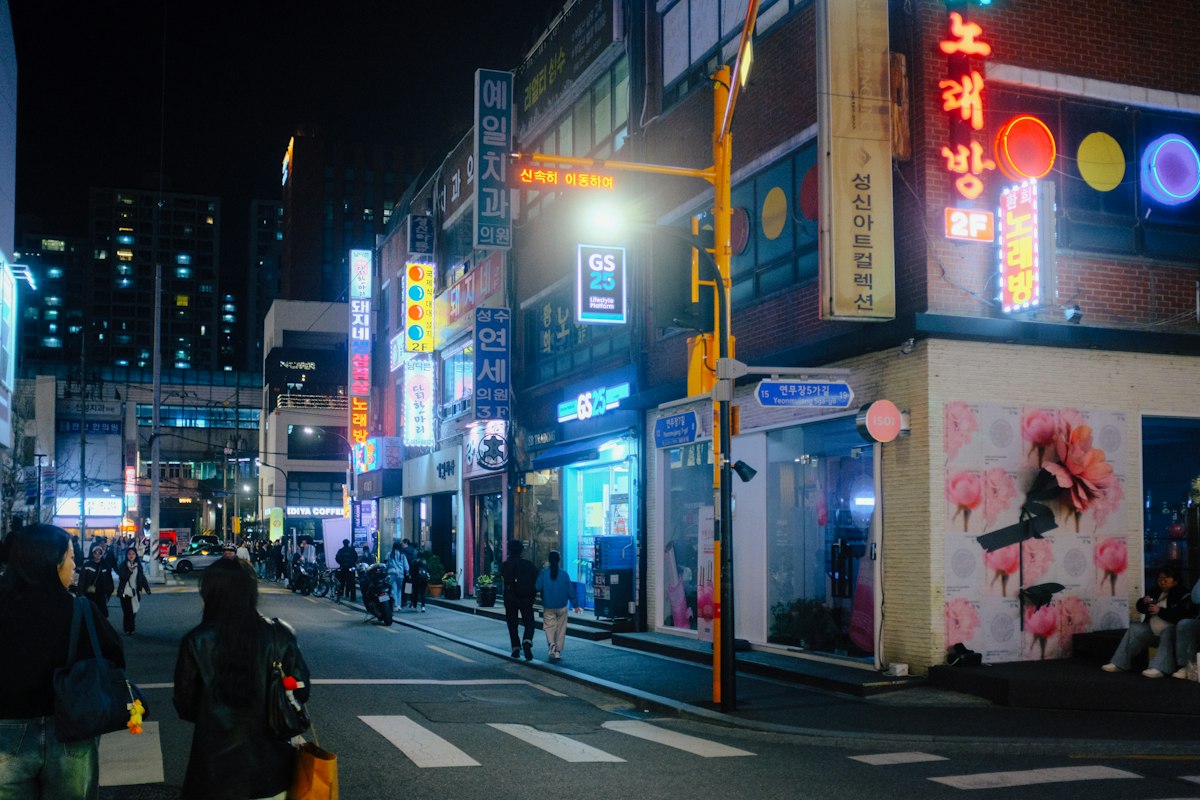
Later during my first year in Seoul, after a long day of exploring, I found myself on a lively Seoul street corner at night. The glowing orange sign of a GS25 convenience store lit up the wet asphalt, and a neon noraebang (karaoke) sign buzzed overhead. I was absolutely starving, so I ducked into a tiny, steamy neighborhood restaurant for a bowl of sundubu-jjigae (spicy soft tofu stew). I had my huge rolling suitcase with me, which awkwardly blocked the narrow aisle. The sweet, older ajumma running the place laughed, patted my shoulder, and shoved my suitcase behind her register counter so I could eat in peace. While Koreans are incredibly kind, relying on the hospitality of restaurant owners to watch your luggage isn’t a viable strategy—it’s always better to use official private storage centers!
Comparing Storage Options in Seoul
To help you decide which service fits your travel style best, here is a quick breakdown of how these luggage solutions stack up against each other:
| Service Type | Average Cost (KRW) | Best For | Pros & Cons |
|---|---|---|---|
| Subway T-Lockers | 2,000 – 4,000 KRW (4 hours) | Quick, short-term stops during transit | Pros: Everywhere, 24/7 access. Cons: Can fill up fast; strict size limits. |
| SAFEX / Airport Delivery | 15,000 – 25,000 KRW per bag | Arrival/Departure days for heavy packers | Pros: Zero lifting, hotel-to-airport convenience. Cons: Requires advance planning. |
| Private Storage Shops | 5,000 – 8,000 KRW (Full day) | Oversized bags, strollers, long-term days | Pros: Friendly staff, secure, fits odd shapes. Cons: Limited operating hours. |
Pro Tips for Tourists
- Avoid Rush Hour: Do not try to move large suitcases on the subway between 7:30 AM to 9:00 AM or 6:00 PM to 7:30 PM. The trains are incredibly packed, and you will face some very unhappy commuters.
- Mind the Station Operating Hours: Subway stations in Seoul generally close around midnight to 1:00 AM. If your bags are in a subway locker, you will not be able to retrieve them until the station reopens at 5:00 AM.
- Take a Photo of Your Locker Location: Seoul’s major stations (like Seoul Station or Gangnam Station) are massive underground labyrinths. If you don’t snap a photo of the locker number and the nearest exit sign, you easily waste an hour trying to find your bags again.
- Check Your Hotel’s Policy: Almost all mid-to-high-end hotels in Seoul will happily store your bags for free before check-in and after check-out. If you are staying at an unstaffed Airbnb, however, you will definitely need to rely on T-Lockers or SAFEX.
Frequently Asked Questions
Can I leave my bags in a subway locker overnight?
Yes, you can leave bags in T-Lockers for up to several days, but be warned: the price accumulates rapidly. After the initial 4-hour block, you will be charged an hourly surcharge. If you leave your bags for more than 3 to 5 days without contacting management, the locker operators may empty the locker and move your belongings to a central warehouse, requiring a hefty retrieval fee.
Are foreign credit cards accepted at Seoul subway lockers?
While most modern T-Locker screens have been updated to accept international Visa and Mastercard, system glitches do happen. To be completely safe, carry a physical T-Money card loaded with Korean Won or have some cash on hand. If you use the T-Locker mobile app, you can easily register your foreign card directly in the app for seamless payment.
How safe are luggage storage services in Seoul?
Seoul is incredibly safe, and theft is exceptionally rare. Subway lockers are monitored by CCTV, and private storage facilities like SAFEX and Travel Depot require ID verification and digital receipts to retrieve bags. You can store your belongings with absolute peace of mind, though it is always smart to keep highly valuable electronics or passports on your person.