

When paying with an international credit or debit card anywhere in South Korea, the correct answer is unambiguous: always choose to pay in Korean Won (KRW). Choosing your home currency—whether that is US Dollars, Euros, British Pounds, Canadian Dollars, or Australian Dollars—triggers a financial mechanism known as Dynamic Currency Conversion (DCC). Rather than saving you money or offering convenience, DCC adds an unnecessary exchange rate markup that inflates your travel expenses.
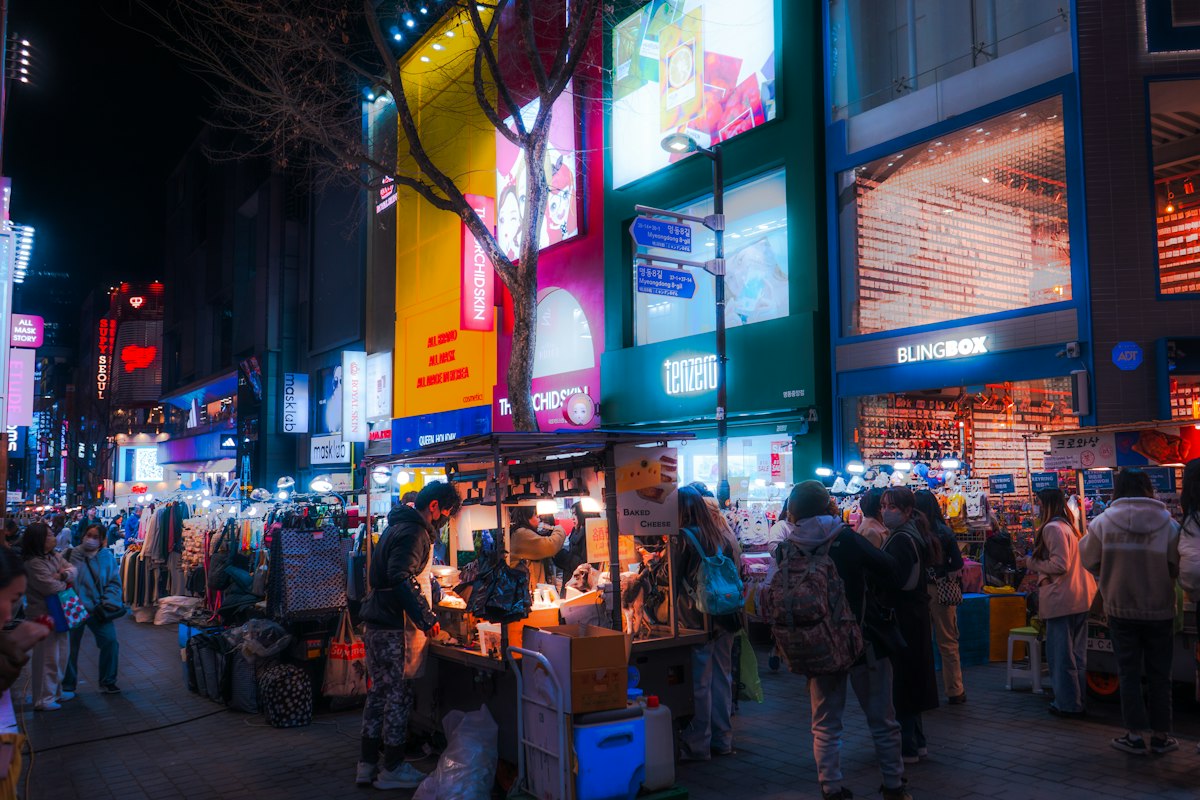
South Korea features one of the most card-friendly economies in the world. From modern department stores in Gangnam and crowded night shopping streets lined with street food carts to quiet, old neighbourhood supermarkets shaded by green striped awnings, payment terminals are ubiquitous. However, point-of-sale (POS) systems at international retailers, major hotels, duty-free shops, and ATMs are frequently programmed to prompt foreign cardholders with a choice between charging in won or in their home currency. Knowing how to recognize this screen and select the right option ensures you never pay avoidable markups on your trip.
- The Core Rule: Always select KRW (South Korean Won) on card terminals and ATMs. Never select your home currency.
- What is DCC? Dynamic Currency Conversion allows a third-party merchant processor or ATM operator to convert the bill into your home currency using their own unfavorable rate instead of your card network’s wholesale rate.
- Published Markup Estimates: Major Korean issuers such as KB Kookmin Card publicly warn that merchant-side DCC markups typically range from roughly 3% to 8% above standard rates.
- Your Consumer Rights: Under international payment network rules (including Visa), merchants must clearly present currency choices, display any markup or fees, and cannot force or pre-select DCC on your behalf.
- Payment Integrity: Declining home currency conversion never cancels or invalidates your purchase; your card will simply process the charge in KRW as standard.
What is Dynamic Currency Conversion (DCC) and How Does It Work?

Dynamic Currency Conversion is an optional payment service offered by merchants, acquiring banks, and ATM network operators. When you insert, tap, or swipe a foreign-issued card, the payment terminal instantly detects the Bank Identification Number (BIN) embedded in your card chip. Recognizing that the card originates outside South Korea, the terminal presents an on-screen prompt asking if you wish to be billed in your domestic billing currency or in Korean Won.
At first glance, seeing your transaction total displayed in your domestic currency looks reassuring. You immediately see a familiar number in dollars, euros, or pounds rather than calculating won amounts with multiple zeroes. However, this convenience comes at a steep price. When you accept DCC, the foreign merchant processor or local ATM operator executes the currency conversion immediately at the point of sale. To handle this conversion, the provider establishes an arbitrary exchange rate that includes a built-in retail spread, far worse than the interbank rate provided by international payment networks like Visa or Mastercard.
Official payment network regulations, such as those maintained by Visa, strictly govern how DCC must be presented to consumers. Visa rules mandate that any terminal or ATM offering currency conversion must disclose the transaction amount in both currencies, clearly show the applicable currency symbols, state the exact exchange rate used, and explicitly list any added fee or percentage markup. Crucially, the merchant is strictly prohibited from selecting the home currency on your behalf or using manipulative terminal interface designs that trick cardholders into choosing conversion. You retain the absolute right to decline the offer.
Why Paying in KRW Saves You Money: The Double Conversion Trap
The financial damage of DCC is compounded by what payment institutions call the “double conversion trap.” Major South Korean card issuers, including Samsung Card and BC Card, regularly issue formal travel advisories to domestic cardholders traveling abroad, cautioning them never to pay in KRW when outside Korea for the exact same reason: paying in domestic currency forces transactions through redundant conversion steps.
When you select KRW at a checkout counter in Seoul, the process is straightforward: the merchant sends a billing request in KRW directly to your card network (Visa, Mastercard, or American Express). The network converts the KRW amount into your home currency using wholesale, interbank exchange rates that sit very close to mid-market pricing. Your home bank then processes the charge, applying any standard foreign transaction fee specified in your cardholder agreement (which is 0% on many popular travel credit cards).
When you inadvertently select your home currency in Korea, a disadvantageous multi-tier conversion occurs:
- The local merchant terminal converts the won total into your home currency using their third-party processor’s inflated exchange rate.
- A processing markup—which major domestic issuer KB Kookmin Card warns can run from roughly 3% to 8%—is tacked onto the baseline calculation.
- Depending on your card issuer’s specific terms, your home bank may still classify the transaction as a foreign purchase because the merchant terminal is based in South Korea, potentially levying an international processing fee on top of the already inflated conversion amount.
A parallel warning is highlighted on domestic platforms like Naver Pay. In their official user guidance, Naver Pay notes that overseas KRW billing triggers unnecessary conversion layers and extra processing costs, whereas local settlement routes follow shorter, cleaner financial paths. Standing as an international visitor inside South Korea, the local currency of settlement is KRW. Opting for KRW ensures your transaction follows the shortest, most cost-effective path available.
| Feature | Paying in KRW (Local Currency) | Paying in Home Currency (DCC) |
|---|---|---|
| Who Sets the Exchange Rate? | Your card network (Visa, Mastercard, Amex) at official wholesale rates. | The local merchant’s acquiring bank or terminal software provider. |
| Conversion Markup | None from the merchant. Only your home card’s foreign transaction terms apply. | Typically 3% to 8% added by the local terminal processor (KB Kookmin Card benchmark). |
| Transaction Route | Direct settlement: KRW routed straight through your payment network. | Double conversion: Merchant converts to home currency, settled abroad. |
| Receipt Clarity | Clear won total matching the shelf or menu price. | Shows home currency amount, markup rate, and original KRW subtotal. |
| Recommended Action | Always Select | Always Decline |
Step-by-Step: How to Reject DCC at Payment Terminals and ATMs
Navigating Korean checkout terminals is straightforward once you know what visual prompts to anticipate. Follow these concrete steps during every card transaction across South Korea.
Step 1: Prepare Your Card for Korean Travel and 3-D Secure
Before departing for Korea, contact your card-issuing bank or update your mobile banking travel settings to indicate that overseas transactions are expected. Verify that your card is registered for 3-D Secure verification (SMS or app-based two-factor authentication), which is frequently triggered when purchasing train tickets on Korail or booking domestic activities online. An automated card decline caused by home-bank fraud filters is fundamentally different from a currency conversion issue, but sorting this out early prevents confusion at the counter.
Step 2: Spot the Currency Prompt at the Checkout Terminal
When the retail cashier inputs your purchase amount, insert your card chip into the terminal or hold it against the contactless reader. Watch the PIN pad or display screen carefully. If the terminal supports DCC, the display will pause and present two buttons or numerical selections: one displaying the price in KRW and another showing an estimated charge in your domestic currency (such as USD or EUR). Press the button corresponding to KRW.
Step 3: Intervene if the Terminal Defaults to Your Home Currency
Occasionally, hurried retail staff in tourist districts may press buttons on the terminal before swiveling it toward you, inadvertently accepting DCC on your behalf. If you see your domestic currency on the terminal screen before entering your PIN or signing, immediately point to the screen and say “Won-hwa-ro gye-san-hae ju-se-yo” (원화로 계산해 주세요 — Please charge in Won), or simply tap the red Cancel button on the keypad. Ask the cashier to reinitiate the transaction in Korean Won.
Step 4: Decline Currency Conversion at Korean ATMs
When withdrawing emergency cash at bank ATMs or convenience store terminals (marked “Global ATM”), the software will often ask whether you accept their conversion rate to debit your home account directly. Select “Decline Conversion” or “Continue Without Conversion”. Choosing to decline ensures your home bank calculates the won withdrawal at network rates. Be aware that the ATM operator’s local usage fee (often 3,000 to 5,000 KRW) and your home bank’s out-of-network ATM fees are separate charges from DCC, and declining DCC does not waive standard ATM operator service fees.
Step 5: Check Your Receipt and Keep It for Issuer Disputes
Always request your customer receipt (yeong-su-jeung) after completing a payment. Examine the currency code printed beside the final charged total. The receipt should read KRW. If the receipt indicates that your home currency was billed along with a conversion rate disclosure that you did not consent to, retain the physical slip. Under Visa and Mastercard rules, your home card issuer is the formal reporting and dispute point for unauthorized or forced DCC transactions.
Navigating Different Shopping Environments in Korea
The prevalence of DCC prompts varies substantially depending on where you make your purchases in South Korea. Understanding local retail environments helps you anticipate when a prompt will appear.
Department Stores, Duty-Free Shops, and Hotels: Large establishments in major tourist hubs—such as Myeongdong, Dongdaemun, or Haeundae in Busan—utilize sophisticated POS networks designed specifically to detect overseas cards. These locations almost always trigger a DCC prompt on the customer-facing display. Because clerks in these venues process hundreds of foreign transactions daily, they may tap through screens rapidly. Keep your eyes on the screen as you insert your card to ensure the transaction remains settled in KRW.
Convenience Stores and Neighbourhood Grocers: In everyday local shops, such as franchise convenience stores (CU, GS25, 7-Eleven) or modest residential supermarkets operating under green awnings in older quarters, terminals are wired purely for the domestic banking grid. Many of these basic terminals lack international DCC software entirely; they process foreign cards directly in KRW without presenting any secondary currency menu. If no currency option appears on screen, your card is automatically billed in KRW at normal network rates.
Street Markets and Food Stalls: In traditional outdoor markets or food carts clustered on evening shopping streets, payment methods split between modern multi-card readers and direct bank transfers. Where physical card readers are accepted, they almost exclusively settle in standard KRW. However, smaller market vendors occasionally prefer cash or domestic payment apps, making it practical to carry a modest reserve of 10,000 KRW and 50,000 KRW banknotes alongside your credit cards.
Pro Tips for Tourists
- Carry a Zero-Foreign-Transaction-Fee Card: The primary reason travelers fall for DCC is the mistaken belief that paying in their home currency dodges foreign transaction fees. In reality, you pay both the DCC markup and potentially a foreign processing fee. Pair a genuine zero-fee travel card with KRW billing for the lowest possible cost.
- Compare the Two Numbers on the Screen: While KB Kookmin Card notes a general warning range of 3% to 8% for DCC markups, exact rates are set by the individual terminal provider. If a terminal displays both figures, take two seconds to divide the home currency amount by the KRW figure. You will immediately notice the spread working against you.
- Watch Out for Deceptive Visual Cues: Some ATM and POS screens highlight the home currency option in a bright, inviting color (like blue or green) while displaying the KRW option in gray or as a plain “Cancel/Decline” text button. Remember: declining the conversion means choosing KRW.
- T-money and Transit Card Recharges: Transit cards like T-money, widely used on the Seoul Subway and public buses, generally require cash for top-ups at automated station kiosks. When withdrawing won cash at an ATM to reload your transit card, decline the ATM’s internal currency conversion screen.
- Check Online Booking Portals: When booking Korean hotel stays, ferry tickets, or local experiences before arrival, check whether the site displays prices in KRW or your home currency. If the website allows you to toggle display currencies, billing in KRW frequently prevents dynamic conversion markups levied by cross-border online merchant gateways.
Frequently Asked Questions
What should I do if a cashier selects my home currency on the terminal without asking?
If the transaction has not yet completed, press the red Cancel button on the terminal keypad immediately and ask the cashier to recharge the bill in KRW. If the payment has already completed and printed, inspect the receipt. If your home currency is shown and you were denied the choice mandated by card network rules, ask the merchant to void or refund the transaction and process it a second time in KRW. If the merchant refuses or cannot void it, retain the receipt showing the conversion details and contact your home card issuer to file a dispute based on unauthorized Dynamic Currency Conversion.
Does declining dynamic currency conversion cancel or fail my payment?
No. According to Visa and Mastercard merchant standards, accepting or declining currency conversion has zero bearing on whether your transaction is approved. Selecting KRW or pressing “Decline Conversion” simply instructs the terminal to route the transaction in South Korea’s native currency. The transaction completes normally, and your home card network performs the conversion using their standard wholesale exchange rate.
Are Korean ATM withdrawal fees the same thing as DCC fees?
No, they are entirely separate charges. A local ATM withdrawal fee is a fixed administrative charge (typically ranging between 3,000 KRW and 5,000 KRW depending on the bank operator) applied for using an out-of-network or foreign card. DCC, by contrast, is an optional exchange rate markup applied if you allow the Korean ATM software to convert the requested won withdrawal into your domestic billing currency. When using an ATM, decline the conversion prompt to avoid the DCC markup; the fixed machine fee will still apply, but your currency exchange rate will remain optimal.