

Misplacing a smartphone, wallet, or passport while traveling in South Korea is stressful, but the country maintains one of the most efficient and centralized lost-and-found infrastructures in the world. High recovery rates are common across Korean public transportation and civic facilities, thanks to systematic recording practices and integrated tracking databases. However, recovering an item requires navigating specific bureaucratic channels, knowing which transportation operator manages your route, and acting before holding periods expire.
Whether you left a shopping bag on a train, dropped a purse in a cab, or forgot a jacket at an airport boarding gate, your retrieval strategy depends entirely on where the item went missing and how you paid for your transit. This guide outlines the exact, step-by-step procedures foreign tourists must follow, including how to search the national police database, bypass domestic online verification barriers, and contact operators directly.
- Call 1330 First: Dial the Korea Travel Hotline (1330) for 24/7 multi-language interpretation; staff can coordinate with subway offices, taxi companies, and police stations on your behalf.
- Search Without Login on LOST112: Use the national police portal (
lost112.go.kr) to browse recovered goods across transit and public venues; online report filing is restricted to Korean phone or ARC holders. - Subway Holding Window: Subways store recovered items at line-specific customer offices for up to 7 days before transferring them to the national police registry.
- Taxi Retrieval Requires Payment Records: Keep your receipts or ride logs. A card or T-money transaction allows the T-money or Cashbee dispatch center to identify the driver’s vehicle immediately.
- Distinguish Airplanes from Terminals: Belongings left aboard an aircraft are processed by the respective airline’s ground team, while terminal losses are handled by airport authorities.
Immediate Action: The Korea Travel Hotline (1330)

Before attempting to contact local precincts or transit customer service desks in Korean, your first move should always be dialing 1330 from any mobile phone or landline (add +82-2-1330 if using an international roaming SIM card). Managed by the Korea Tourism Organization (KTO), this service operates 24 hours a day, 7 days a week, offering real-time assistance in English, Japanese, and Mandarin.
The 1330 agents act as real-time liaisons. If you know the station where you exited or have a taxi license number, the agent will initiate three-way calls with station masters, dispatch centers, or lost-and-found officers. They can translate descriptions of unique items, verify if an article matching your description has arrived at a central depot, and supply the precise physical address you need to visit for retrieval.
How to Use the LOST112 Police Database
The Integrated Police Lost and Found System, known nationally as LOST112 (lost112.go.kr), serves as the master database for South Korea. Every item recovered by police officers, handed in by citizens, or transferred from transit hubs after initial holding windows is photographed, cataloged, and uploaded to this portal.
Step 1: Searching the Portal (No Login Required)
Foreign tourists do not need an account to search for recovered belongings. Navigate to the website or download the mobile app (경찰청 대중교통 분실물) and select Search Found Articles (습득물 검색). The search filters allow you to narrow down items by category (electronics, bags, wallets), geographical territory (e.g., Seoul, Busan, Incheon), date of loss, and color. Use Google Translate or browser translation if viewing the desktop site, and search broad English terms or Korean brand names if applicable.
Step 2: Understanding the Online Filing Restriction
A major point of friction for international travelers occurs when attempting to submit a formal “Lost Article Report” (분실물 신고) on the website. The registration form requires identity verification through a domestic Korean mobile carrier (PASS app / SMS verification) or an Alien Registration Card (ARC). Short-term tourists using travel eSIMs or international roaming cannot pass this digital identity check.
Step 3: Filing a Report In Person
If your item does not appear in search results, you must register the loss manually. Walk into the nearest police station (경찰서), patrol division (지구대), or substation (파출소). Bring your original Passport. The front-desk officer will record your statement, take your temporary local contact details (such as your hotel address and email), and enter the official lost-item report into the LOST112 system on your behalf.
Recovering Items Lost on the Subway
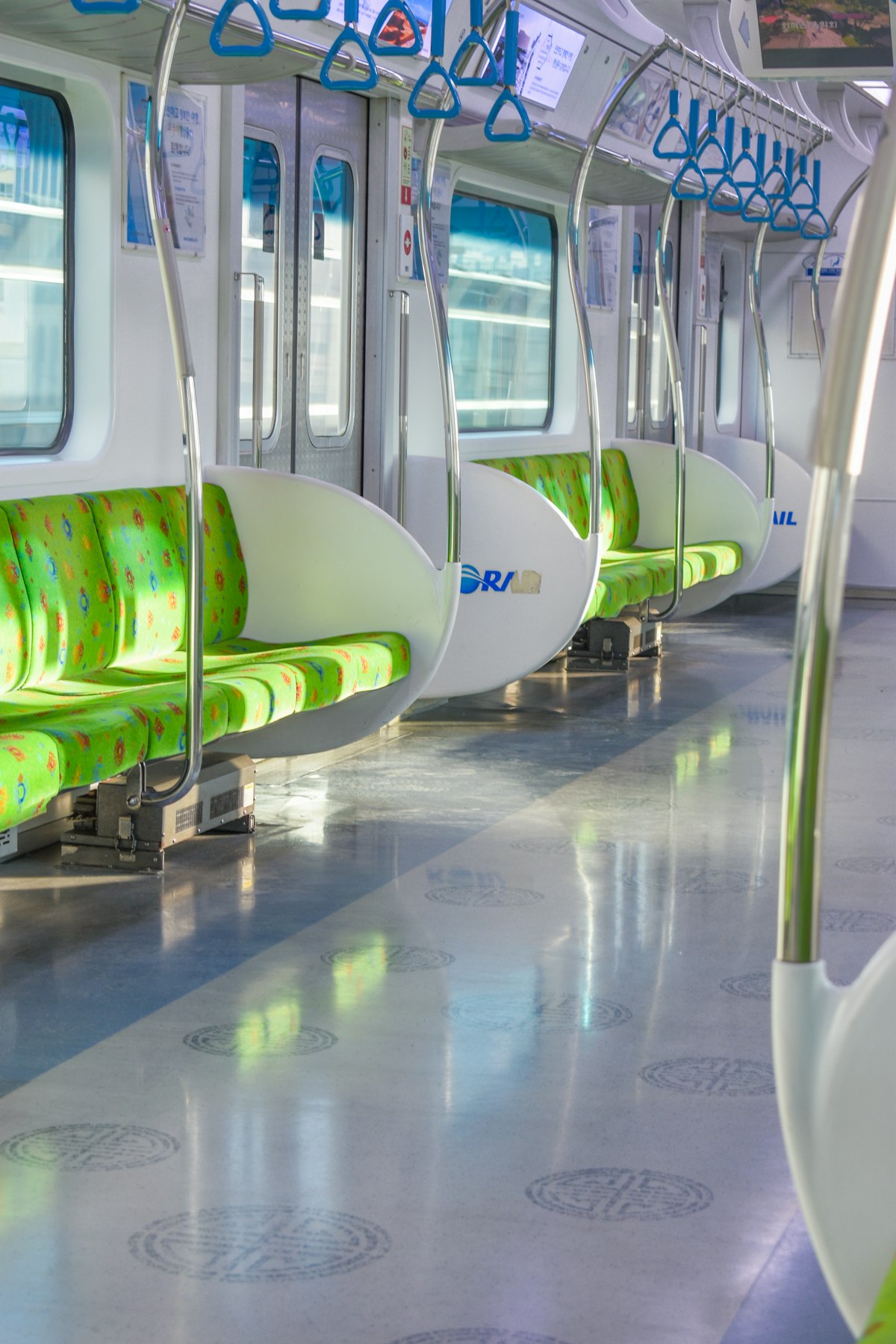
When you step off a train and realize you left an umbrella, backpack, or shopping bag behind on the overhead rack, act immediately. While seeing an empty Seoul subway car with green seats and blue hand straps pull away can cause panic, the transit system is heavily monitored and items are regularly turned in by cleaning crews or fellow passengers.
1. Record Critical Train Details
Before approaching station staff, document the following variables: the subway line number, the station where you got off, the direction the train was traveling (its final terminus station), the exact time you exited, and your car number. The car number is a four- or six-digit code visible on the platform screen doors or on the interior carriage doorway edges.
2. Contact the Station Office Immediately
If you realize your loss right away, walk straight to the station control office (역무실) at your current stop. If you provide the train car number and time, the station manager can radio ahead to the train conductor or platform staff at a upcoming station to inspect the car before the train reaches the terminus.
3. Identify the Line Operator
Seoul’s rail network is divided among multiple corporate entities. Seoul Metro operates Lines 1 through 8 (and shares portions of Lines 1, 3, and 4 with Korail). Korail manages suburban extensions, the Suin-Bundang Line, and the Gyeongui-Jungang Line. The AREX airport line and the Shinbundang Line operate under independent concessions. Always ensure you are checking with the specific operating agency that manages your section of track.
4. The 7-Day Transfer Rule
Subway customer service centers hold uncollected belongings for up to 7 days. Standard operating hours for central subway lost-and-found offices are weekdays from 09:00 to 18:00 (weekend and public holiday access varies by operator and must be confirmed locally). After 7 days, all unclaimed property is transferred directly to the National Police Agency and registered on the LOST112 portal.
Tracking Items Left in Taxis
Leaving a bag inside an orange Seoul taxi with a lit TAXI roof sign in night traffic can feel like an impossible situation, but South Korea’s digital transaction tracking makes cab recovery straightforward—provided you have a payment trail.
Scenario A: Paid by Card or T-money
If you tapped a physical credit card, debit card, or T-money transit card to pay the fare, call the automated T-money Taxi Service Center at 1644-0088 (or the Cashbee center for non-T-money regional systems). Dial the line and follow prompts to input your card number and transaction date. The automated system checks the fare record and sends the vehicle’s official license plate number and the driver’s direct mobile or company dispatch phone number via SMS. If you cannot understand the automated Korean voice system, call 1330 and have the representative make this inquiry with your card digits.
Scenario B: Booked via Kakao T
If you booked the ride through the Kakao T mobile application, open the app, navigate to My Info, and tap Ride History. Open the completed trip log. Within the trip record, use the Call Driver button or use customer support messaging to report an item left in the vehicle. Drivers frequently return to the drop-off location or drop the item at the nearest local police substation.
Scenario C: Paid with Cash
If you paid cash and received a printed receipt (영수증), the taxi company name, license plate number, and phone number are printed directly on the slip. If you paid cash and refused the paper receipt, tracking becomes exceptionally difficult. In this case, file a report with the police via 1330 or a local station; officers can sometimes inspect public traffic CCTV footage around your drop-off intersection to identify the license plate, though this is subject to local station resources and traffic camera angles.
Airport Recoveries: Incheon and Gimpo Terminals
One of the most frequent mistakes travelers make is contacting the wrong entity when an item is lost at an airport. There is a strict division of responsibility between the aircraft cabin and airport ground property.
Cabin Property (The Airline)
If you left your passport, tablet, or headphones in a seatback pocket or overhead bin aboard the plane, do not go to the airport terminal lost-and-found. Terminal authorities have no jurisdiction over aircraft interiors. You must contact the specific airline’s ground handling office at that airport directly.
Terminal Property (Airport Authority)
Items dropped in security lines, duty-free zones, check-in halls, or boarding gates are collected by the airport operator. At Incheon International Airport (ICN), check the official portal at airport.kr. Physical service centers are located in:
- Terminal 1: Transportation Center, B1 East Side.
- Terminal 2: Transportation Center, B1 Center.
Note on Operating Hours: Exact daily operating schedules for Incheon Airport lost-and-found desks are subject to administrative adjustments. Verify the current service schedule directly with Incheon International Airport Corporation via their website or terminal information desks.
Fees, Retention Rules, and Identification Requirements
Under standard South Korean public policy, claiming lost property in person is free of charge. You will never be asked to pay an administrative release fee or processing surcharge by police stations, subway offices, or airport desks.
| Entity / Process | Standard Retention Limit | Associated Fees (KRW) | Required Claim Identification |
|---|---|---|---|
| Subway Offices (Seoul Metro / Korail) | Up to 7 days (transferred to police thereafter) | 0 KRW (Free in-person pickup) | Physical Passport, item description / unlock code |
| Police Stations & LOST112 | 6 months (under Korean Civil Act) | 0 KRW for pickup; postal fees vary if delivered | Physical Passport, IMEI number or ownership proof |
| Airport Terminals (ICN / GMP) | Stored locally, then transferred to police | 0 KRW (Free in-person pickup) | Passport, Boarding Pass (recommended) |
| Courier Delivery (Domestic Service) | Arranged upon individual request | Varies by weight (Cash on Delivery / 착불) | Korean local address and recipient phone number |
If you cannot retrieve the item in person and are still inside South Korea, certain stations or police precincts can arrange local courier shipping (Post Office parcel or domestic “quick service” motorcycle courier). The receiver must pay shipping costs upon arrival in Cash (KRW) as cash on delivery (착불). Note that whether police stations or transit offices offer direct international shipping abroad is unknown; in most cases, public facilities do not ship internationally, requiring you to authorize a local friend, concierge, or third-party proxy service with a power of attorney.
Common Tourist Mistakes to Avoid
Many international visitors fail to recover their belongings due to avoidable missteps:
- Declining Taxi Receipts: Always take a paper receipt if you pay with cash. Without a receipt or app history, the vehicle cannot be identified by dispatchers.
- Failing to Prove Device Ownership: When claiming a smartphone or laptop, officers will not release the item based on verbal description alone. You must know the device unlock code, pattern, serial number, or IMEI number.
- Visiting the Wrong Station: Regional subway extensions in Greater Seoul and lines in Busan, Daegu, or Daejeon have independent administrative hubs. Always confirm the exact operating authority before traveling across town. Operating hours for regional transit offices outside Seoul are subject to local network policies and should be verified in advance.
- Assuming an Item is Stolen: Theft rates for dropped personal items in Korea are low; most items are turned in. Do not immediately assume an item is permanently lost before thoroughly searching LOST112.
Pro Tips for Tourists
- Take a Photo of Your Subway Carriage Number: Whenever you board a train with luggage, snap a photo of the 4- or 6-digit carriage number stamped by the door.
- Pay for Every Taxi Digitally: Use your T-money card or credit card for all street-hailed taxis so the transaction is automatically recorded in the central database.
- Keep Your Hotel Card Handy: If calling 1330 to arrange taxi return, drivers often agree to drop your item off at your hotel front desk if you agree to cover the metered fare.
- Photograph Electronic Serial Numbers: Keep a photo of your phone’s IMEI number, camera serial numbers, and passport information page in cloud storage before your trip.
- Check LOST112 Daily: There is often a 24- to 48-hour delay between an item being handed to a train conductor and its official digital cataloging on the police portal.
Frequently Asked Questions
Can the police or subway station mail my lost item to my home country?
Direct international shipping policies from municipal police stations and public transit offices are generally unavailable or unverified as standard practice. If you have already left South Korea, you will typically need to appoint a representative residing in Korea (such as a friend or proxy recovery service) with a copy of your passport and an authorization letter to collect the item in person and ship it overseas via Korea Post EMS.
What should I do if I don’t speak Korean when contacting a lost and found center?
Do not attempt to call individual Korean service centers directly if you only speak English. Instead, call the Korea Travel Hotline at 1330. Their multilingual staff will contact the transit operator, taxi driver, or police station on your behalf and conduct the entire inquiry with three-way real-time interpretation.
How long do I have before my lost property is discarded or auctioned off?
Subway offices hold belongings for 7 days before transferring them to the police. Under Article 253 of the Korean Civil Act, the police retain items for 6 months. If unclaimed after 6 months, ownership may be transferred to the finder (if claimed within 14 days) or to the National Treasury, after which items are auctioned off, donated, or destroyed.