

Walking down the vibrant, neon-lit restaurant streets of Seoul, Busan, or Jeju, one distinct aroma inevitably draws you in: the mouth-watering scent of caramelizing pork belly and marinated beef sizzling over charcoal grills. Korean BBQ, known locally as gogi-gui, is far more than a simple dinner choice in South Korea. It is a immersive cultural ritual, a social celebration, and an essential culinary highlight for millions of travelers visiting the country every year.
For first-time international visitors, stepping into a bustling Korean BBQ establishment can feel equal parts exciting and intimidating. Between glowing charcoal briquettes, hiss of searing meat, call buttons, and endless arrays of colorful small side dishes, it is completely natural to feel uncertain about what to do first. Who cooks the meat? How do you assemble a proper wrap? What should you do with all those small side dishes? By learning a few fundamental table rules and dining customs, you can easily navigate any BBQ joint like a seasoned local and enjoy an unforgettable feast.
- Ordering Minimums: Most traditional BBQ restaurants require ordering a minimum of two portions to start, or one portion per person in your group.
- Grilling Protocol: Restaurant servers frequently assist with cooking, but if tongs are placed near you, you are expected to monitor and flip the meat.
- Grill Types Matter: Flat metal plates or stone slabs are reserved for unmarinated pork; open wire mesh grills are used for marinated meats over direct fire.
- The One-Bite Ssam Rule: Lettuce wraps (ssam) containing meat, sauce, and toppings should be eaten in a single bite for the optimal blend of flavors.
- Two-Handed Courtesy: Use both hands when pouring drinks for companions or receiving side dishes from the staff.
Ordering Basics: Portion Sizes and Meat Selections

When you first sit down at a Korean BBQ restaurant, understanding the menu setup is your first hurdle. Unlike standard Western restaurants where each guest orders a standalone main dish, Korean BBQ is inherently family-style. Meat is ordered by specific cuts and measured in grams per portion, usually ranging between 150g and 200g per order.
The golden rule of ordering K-BBQ is the minimum portion policy. Almost all restaurants require a minimum order of two portions of meat to start the grill, even if you are dining alone. If you are dining in a group of three, ordering three or four total portions is standard practice. Furthermore, many traditional venues require you to order at least two portions of the same type of meat before switching to a different cut.
Popular Cuts You Should Know
Korean BBQ menus primarily divide meats into pork (dwaeji-gogi) and beef (so-gogi), as well as unmarinated versus marinated options:
- Samgyeopsal (Thick-cut Pork Belly): The undisputed king of Korean BBQ. It is unmarinated, rich, juicy, and usually grilled alongside garlic and kimchi.
- Moksal (Pork Neck Shoulder): A leaner cut of pork that offers a rich, beef-like chew without excessive fat.
- Galbi (Short Ribs): Available in both pork and beef. It is often marinated in a sweet and savory soy-garlic sauce (dwaeji-galbi or so-galbi).
- Chadolbaegi (Thinly Sliced Beef Brisket): Paper-thin beef brisket that cooks on the grill within seconds, dipped simply in toasted sesame oil with salt and pepper.
Grill Mechanics: Who Cooks and How to Manage the Fire
One of the most common questions foreign tourists ask is: Who is supposed to grill the meat? The answer depends entirely on the type of restaurant you visit. At high-end beef places or modern pork specialty shops, dedicated servers will cook every piece of meat to perfection for you. However, at classic neighborhood joints, you are expected to take charge of the tongs and kitchen scissors.
A great rule of thumb is to observe the staff. If a waiter places the raw meat on the grill and leaves the tongs right beside your plate, that is your cue to take over. If you are dining with Korean friends, usually the youngest or the person sitting closest to the tongs takes responsibility for flipping and cutting the meat into bite-sized pieces.
The Importance of Changing the Grill Plate
Korean BBQ utilizes two primary types of cooking surfaces: solid cast-iron/stone plates and open wire mesh grates. Unmarinated fat-heavy cuts like pork belly generate lots of rendered grease and require a solid slanted plate with a drain hole to prevent excessive flare-ups. Marinated meats containing sugar, like sweet galbi, burn easily and are cooked over wire mesh directly over open embers.
If you decide to switch from unmarinated pork belly to marinated galbi later in your meal, the restaurant staff will completely replace your cooking surface. Over time, sugar and fat will burn onto the grate. Never hesitate to politely catch a server’s attention and ask for a fresh grill grate by saying “Bulpan gyochae haejuseyo” (Please change the grill plate).
Mastering the Art of Ssam (Lettuce Wraps) and Banchan
Eating Korean BBQ is an interactive, customizable experience centered around ssam (meaning “wrapped”). Along with your meat comes an impressive array of complimentary side dishes called banchan, fresh leafy greens, sauces, and raw garlic. Building the perfect wrap balances rich, fatty meat with fresh, pungent, and savory elements.
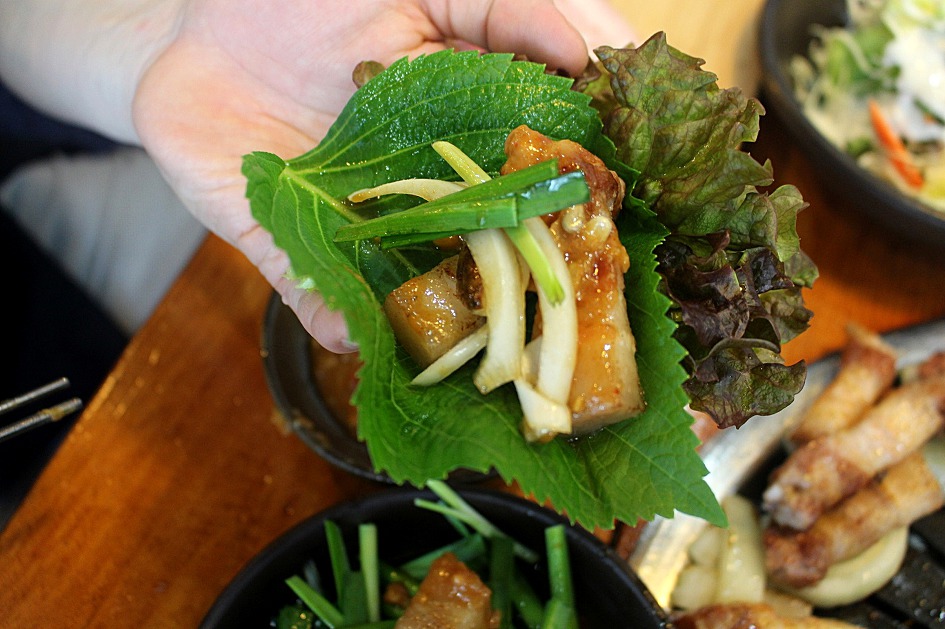
To create a classic wrap, place a crisp lettuce leaf or a herbal perilla leaf flat in your palm. Add a piece of hot, grilled meat dipped lightly in ssamjang (a savory mixture of fermented soybean paste and chili paste). Add a slice of grilled garlic, a pinch of seasoned green onion salad (pachae), and perhaps a bit of grilled kimchi. Fold the leaf into a neat package.
The golden rule of ssam etiquette is to eat the entire wrap in a single bite. Biting a wrap in half often causes sauce and juices to leak out, which is considered messy and uncoordinated. Make your wraps comfortably small so you can pop them in whole!
Essential Do’s and Don’ts at the Korean BBQ Table
To help you feel completely confident during your meal, here is a quick reference guide comparing proper etiquette with common mistakes to avoid:
| Category | Do (Proper Etiquette) | Don’t (Faux Pas to Avoid) |
|---|---|---|
| Grilling | Use dedicated tongs or communal scissors to handle raw meat on the fire. | Don’t use your personal chopsticks to continuously turn raw pork on the grill. |
| Side Dishes | Feel free to grill kimchi, garlic, and bean sprouts alongside fat-rich meats. | Don’t throw raw garlic or kimchi onto wire mesh grills where they drop into coals. |
| Drinking | Pour drinks for your companions using two hands to show respect. | Don’t refill your own alcoholic shot glass while leaving your friend’s glass empty. |
| Table Service | Press the table call button (bel) when you need service or refills. | Don’t shout loudly across a busy room if your table has an integrated call button. |
Pro Tips for Tourists
- Store Your Clothes Inside the Chair: Korean BBQ smoke is incredibly aromatic, but it will linger on your jacket. Most BBQ venues feature hollow drum chairs or plastic containers where you can stow your coats, bags, and scarves during the meal.
- Look under the Table for Utensils: If you don’t see chopsticks or napkins on top of your table, check the side drawer built right beneath the table rim.
- Order Savory Stews to Finish: Locals rarely finish a meal with just meat. It is custom to order a bowl of soybean paste stew (doenjang-jjigae) or cold buckwheat noodles (naengmyeon) with a bowl of white rice to round off the meal.
- Utilize Self-Service Bar Refills: Most modern establishments feature a self-bar where you can freely grab extra lettuce, perilla leaves, garlic, kimchi, and dipping sauces without bothering the waitstaff.
- No Tipping Required: Tipping is non-existent in South Korea. The price listed on the menu is the exact final amount you pay at the front register upon leaving.
Frequently Asked Questions
Can I eat Korean BBQ alone as a solo traveler?
Yes, you can eat Korean BBQ solo! While K-BBQ is traditionally a communal dining experience, solo travel in Korea is becoming increasingly popular. To dine alone, you generally must order a minimum of two portions of meat (which is easily doable for an eager diner). Alternatively, look for modern single-diner BBQ spots labeled Honbap friendly, especially around university neighborhoods like Hongdae or Sinchon.
Are side dish refills really free in South Korea?
Yes! All standard banchan—including kimchi, pickled radish, salad, garlic, and fresh wrapping leaves—are completely free and unlimited. You can ask a server for extra portions or fill your plate at the restaurant’s self-service bar. Premium items like extra meat, bowls of rice, specialty stews, or alcoholic beverages will be billed separately.
How do I know when the meat is fully cooked?
Thin cuts of beef like brisket cook within 10 to 15 seconds per side and can be eaten as soon as the pink hue disappears. Pork cuts like samgyeopsal and moksal must be thoroughly cooked until golden brown on both sides. If you are unsure, use your kitchen scissors to cut a piece open; if the inside is completely firm with clear juices, it is ready to enjoy.