

South Korea is a global culinary paradise, offering everything from sizzling Korean barbecue and rich, bubbling stew pots to crunchy double-fried chicken and bustling street market snacks. However, for many international tourists visiting Seoul, Busan, or Jeju, stepping into a local eatery where the menu is written entirely in Hangul (the Korean alphabet) can feel intimidating. You might worry about accidentally ordering something too spicy, not knowing how to get the waiter’s attention, or getting stuck at an automated self-service machine.
The great news is that South Korea is one of the most technologically advanced and customer-convenient countries in the world. Dining out here is surprisingly visual, highly streamlined, and very welcoming to non-Korean speakers once you understand the basic systems. Whether you are using translation applications, press-to-order table buttons, or visual picture menus at traditional night markets, this comprehensive guide will equip you with all the essential tools, apps, and practical etiquette to order food seamlessly across South Korea without speaking a word of Korean.
- Translation Apps: Download Naver Papago for accurate live camera menu translation—it performs much better than standard translation apps for Korean text.
- Table Bells: Look for a small call button (벨) attached to your restaurant table; pressing it alerts the waitstaff that you are ready to order or need assistance.
- Kiosks: Most modern cafes, fast-food outlets, and ramen shops use touchscreen kiosks that feature an English language option located at the top corner of the screen.
- Self-Service: Water and extra side dishes (banchan) are frequently self-service in casual eateries—look for signs reading “물은 셀프” (Water is self-service).
- Street Markets: Vendors rely heavily on visual sample displays, photo menus, and clear price lists, making pointing and gesturing fully effective.
Essential Apps to Download Before You Eat

Your smartphone is your ultimate dining companion in South Korea. While Google services work to a degree, local South Korean apps provide vastly superior accuracy, detailed menu photos, and real-time machine translation tuned specifically to food terminology.
1. Naver Papago (The Translator Standard)
If you only download one app for your trip, make sure it is Naver Papago. Created by Korea’s leading tech company, Papago excels at translating context-heavy Korean language. Its real-time camera feature allows you to point your phone directly at wall menus, handwritten blackboards, or printed receipts. It instantly overlays readable English text over the original characters. This is especially useful for identifying meat cuts at barbecue restaurants or recognizing spicy indicators.
2. Naver Map & KakaoMap (Navigation & Menu Previews)
Google Maps has limited functionality in South Korea due to national security mapping regulations. Download Naver Map or KakaoMap instead. Both apps allow you to search for nearby restaurants, view star ratings, and read visitor reviews. Crucially, restaurant listings in Naver Map almost always include a dedicated tab containing clear, high-resolution photo menus uploaded by the owners and recent guests. You can easily select what you want before even entering the establishment.
3. CatchTable Global (Reservations & Waiting Lines)
Popular restaurants in trendy districts like Seongsu, Hongdae, or Gangnam often require queuing or signing up on an electronic waitlist at the door. CatchTable Global is an English-friendly platform tailored for foreign tourists. It allows you to make advance reservations at high-end dining spots or join remote waitlists, bypassing the need for a local Korean phone number.
Navigating Automated Ordering Kiosks
Self-service digital kiosks (키오스크) are everywhere in urban South Korea. You will encounter them in fast-casual diners, boba tea shops, dessert places, gimbap chains, and ramen bars. Ordering via kiosk removes spoken language barriers completely, but navigating the interface for the first time requires knowing where to look.
When you approach a touchscreen kiosk, look immediately at the top right or top left corner for a language toggle option. You will usually see a small globe icon, an American/British flag icon, or text that reads “English”, “Eng”, or “EN”. Selecting this will instantly convert major categories and item names into English.
If the kiosk does not have an English toggle, simply open your Naver Papago app and hold your camera over the screen using the real-time image translation mode. Standard kiosk workflows in Korea follow a predictable sequence: choose whether your meal is “For Here” (매장 – Maejang) or “Takeout” (포장 – Pojang), select your dishes, choose customized toppings or spice levels, select payment method (typically foreign credit card / IC chip), insert your card into the illuminated card slot at the bottom, and take your printed receipt featuring your queue call number.
Understanding Table Service and Bell Culture
Traditional sit-down restaurants in South Korea prioritize speed and customer privacy. Unlike Western dining culture where waitstaff check in periodically throughout your meal, Korean servers will generally leave you completely undisturbed until you explicitly call for them.
Look closely at your table setup. In many mid-range and casual eateries, you will find a small round plastic call button (호출벨) stuck to the tabletop, the side of the table frame, or next to the napkin box. Pressing this button rings a chime in the kitchen and lights up your table number on a wall display panel. When the server arrives, you can point to the item on the printed menu or show a translated note on your phone.
If your table does not have a call bell, you can politely call out to the staff across the room. Raise your hand slightly and say “Jeogi-yo!” (저기요), which translates to “Excuse me!” or “Over here!” Staff will quickly respond and take your order. To request the bill or pay, simply walk up to the counter near the main exit door—it is customary in Korea to pay at the cash register near the front door rather than leaving money on the table.
| App / Service | Primary Function | Best Tourist Use Case |
|---|---|---|
| Naver Papago | Live Camera & Text Translation | Translating physical paper menus, wall menus, signs, and payment receipts. |
| Naver Map | Local Map & Business Search | Checking menu photos, operating hours, prices, and visual dishes beforehand. |
| CatchTable Global | Restaurant Reservations & Queuing | Booking popular dining spots and remote waiting without a local Korean phone number. |
| Shuttle Delivery | English Food Delivery App | Ordering late-night meals directly to your hotel or Airbnb using foreign credit cards. |
Ordering at Traditional Markets and Street Food Stalls
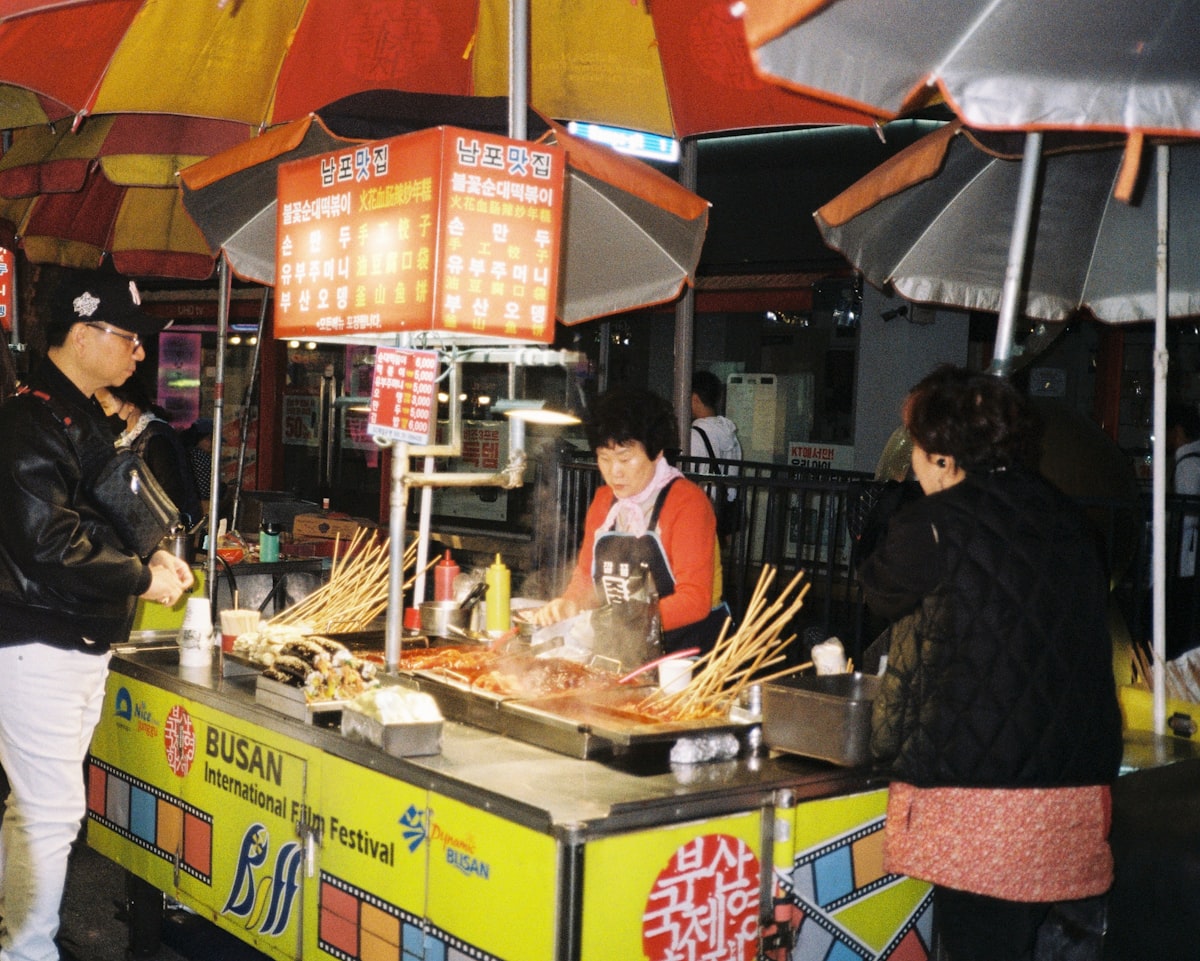
Visiting iconic traditional markets—such as Gwangjang Market or Mangwon Market in Seoul, or Jagalchi and Bupyeong Kkangtong Markets in Busan—is a highlight of traveling in Korea. Street food stalls (Pojangmacha) and market vendors present a vibrant, fast-paced dining environment where verbal communication is secondary to visual cues.
At street stalls, food items like tteokbokki (spicy rice cakes), twigim (crispy deep-fried fritters), sundae (blood sausage), and eomuk (fish cake skewers) are arrayed directly in front of you. Pointing at the specific item you want and holding up fingers to indicate quantity is completely acceptable and widely expected. Many vendors display clean price placards right in front of the cooking stations, making calculations straightforward.
When eating standing up at a market stall, feel free to help yourself to broth cups provided near the fish cake skewers (eomuk-guk). Payment at small street carts is usually cash-friendly, though major city market vendors increasingly accept credit cards and T-money transit cards. Simply hand your cash or card directly to the cook or place it in the designated payment dish on the counter.
Pro Tips for Tourists
- Locate Hidden Cutlery: Do not panic if you sit down and see no chopsticks or spoons on the table. Pull open the side drawer hidden built directly under the edge of your dining table—it contains napkins, wet wipes, and wrapped utensils.
- Check for Self-Service Water: Filtered water stations are standard in Korean restaurants. If staff do not bring a water bottle to your table right away, look for a cold stainless-steel water dispenser marked “물은 셀프” (Water is self-service) and grab a cup.
- Understand Minimum Portion Rules: At Korean BBQ (K-BBQ) establishments, there is typically a minimum initial order requirement of two portions of meat (2인분), even if you are dining as a solo traveler.
- Keep a Screenshot of Dietary Needs: If you have severe allergies, strict vegetarian preferences, or prefer non-spicy food, save a translated card on your phone showing Korean text like “매운 거 못 먹어요” (I cannot eat spicy food) or “견과류 알레르기가 있어요” (I have a nut allergy).
- Tipping is Not Practiced: Tipping does not exist in South Korea. The price listed on the menu is the exact final price including tax and service. Attempting to leave money on the table may cause confusion as staff will run after you to return forgotten cash.
Frequently Asked Questions
Can I use international credit cards at Korean restaurants and kiosks?
Yes! Major international payment networks including Visa and Mastercard are accepted almost universally throughout South Korea, including at electronic ordering kiosks, chain restaurants, cafes, and sit-down diners. Always remember to insert your physical chip card into the base of the machine rather than tapping, as contact chip insertion is standard practice across Korean payment terminals.
Is it easy to find vegetarian or vegan food without speaking Korean?
While traditional Korean cuisine heavily features fish sauce, anchovy stock, and meat broths even in vegetable dishes, modern urban areas like Seoul have seen a boom in dedicated plant-based dining. Using localized apps like HappyCow alongside Papago to translate ingredients will ensure you safely find vegan-friendly options without miscommunication.
What basic Korean words are most useful for ordering food?
Learning just three polite phrases will make your dining experience even smoother: “Jeogi-yo” (Excuse me / Calling server), “I-geo ju-se-yo” (Please give me this item while pointing), and “Kamsa-ham-nida” (Thank you). Korean restaurant owners appreciate the effort, and combining these words with visual pointing works every single time.