

When I first landed in Seoul five years ago, I treated the city bus system like a high-stakes puzzle I was terrified of failing. I remember standing outside near the Itaewon subway station Exit 1 sign at nearly 1:00 AM, clutching my phone with 4% battery, completely convinced I was going to have to spend 35,000 KRW (~$26 USD) on a taxi back to my apartment in Mapo. Subways had already shut down, and the digital bus stop sign was blinking in fast Korean characters. I took a deep breath, boarded a late-night N-Bus (Night Bus), tapped my card, and realized within three stops that I had needlessly feared the most efficient, hyper-connected surface transit system on earth.
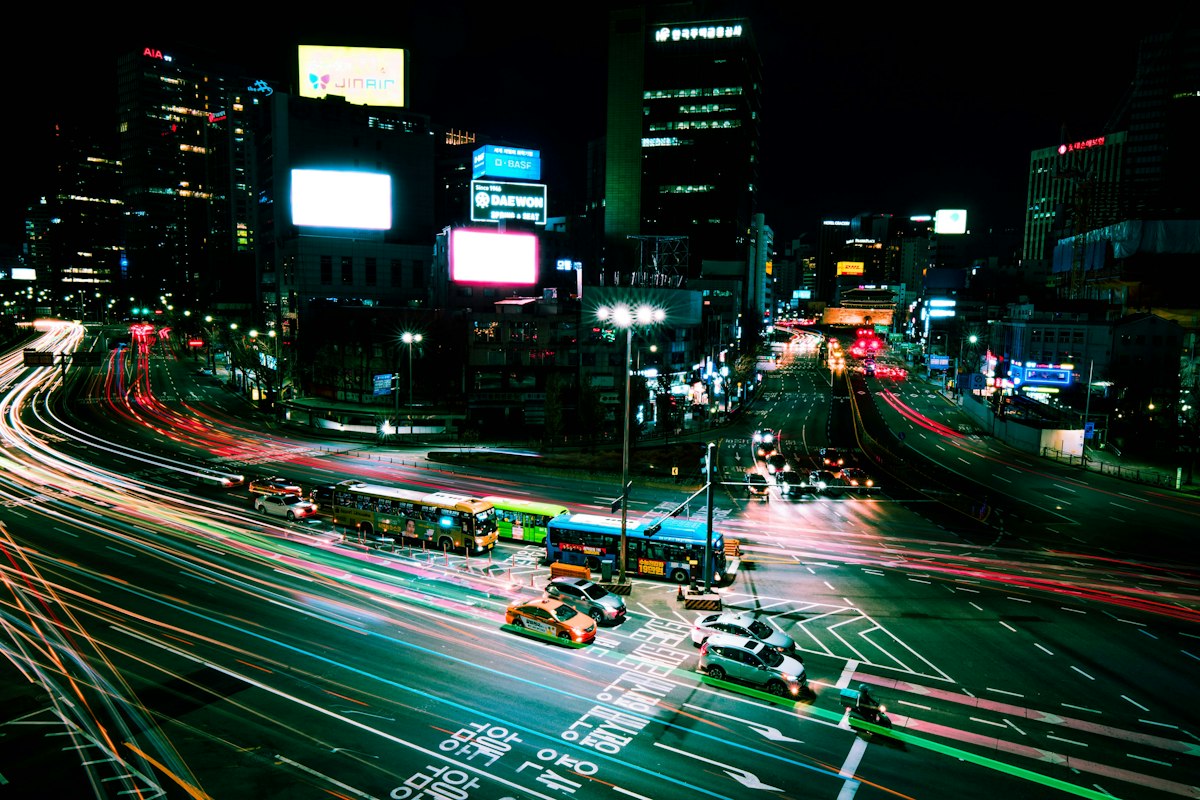
Most international tourists stick strictly to the subway because underground platforms feel safe and predictable. But by avoiding the bus, you miss out on watching the city come alive. There is nothing quite like sitting in the front row of a blue trunk bus, gazing out as light trails from buses and cars stretch across a massive Seoul intersection at night. Once you master two simple tools—a T-Money card and Naver Map—riding Seoul’s city buses is cheaper, faster, and infinitely more scenic than underground travel. Here is my complete, battle-tested guide to riding Seoul buses without losing your mind.
- Primary Payment: T-Money Card or WOWPASS (1,500 KRW base fare / ~$1.15 USD). Cash is no longer accepted on almost all Seoul routes.
- Essential App: Download Naver Map before arriving. Google Maps does not provide real-time bus walking paths or live arrival times in Korea.
- Golden Rule: Always tap your card when boarding and exiting to lock in free transfer discounts across subways and buses.
- Bus Hierarchy: Blue = Main roads/Long distance; Green = Feeder routes to subways; Yellow = Tourist loops; Red = Express/Intercity; Night (N) = 11:30 PM–6:00 AM.
Why You Should Ditch the Subway for Seoul’s City Buses

Seoul’s subway is world-class, but it has one massive drawback: stairs. Deep underground stations like Myeongdong, Gangnam, or Yeouido often require walking down three sets of staircases, navigating long subterranean corridors, and climbing back up. On a hot August day or after hitting 25,000 steps during a day of sightseeing, those subway stairwells feel brutal.
Buses, on the other hand, drop you off right at street level. If you are heading from Gwanghwamun Plaza down to Bukchon Hanok Village, taking a Green feeder bus saves you 15 minutes of underground trekking. Plus, dedicated center-lane busways allow buses to slice right through peak-hour traffic while passenger cars sit paralyzed. You get an elevated tour of Namsan Tower, historic palace gates, and neon-lit districts while sitting in air-conditioned comfort for a fraction of the cost of a taxi.
Decoding Seoul’s Bus Color System
At first glance, Seoul’s fleet of colored buses looks like an oversized bowl of Skittles. But the colors are actually a brilliant color-coded grid system designed to tell you instantly where a vehicle is headed.
| Bus Color | Route Type | Base Fare (Adults) | Best For Tourists |
|---|---|---|---|
| Blue Buses | Trunk routes across major arterial roads connecting outer districts to Downtown. | 1,500 KRW (~$1.15) | Longer trips across the Han River or traversing major sightseeing hubs. |
| Green Buses | Feeder routes linking residential areas and local spots directly to subway stations. | 1,500 KRW (~$1.15) | Short hops, navigating steep hills (like Seongbuk-dong or Namsan foothills). |
| Yellow Buses | Circulating routes around key downtown tourist areas and shopping belts. | 1,400 KRW (~$1.05) | Quick loops around Namsan Mountain, N Seoul Tower, and central shopping zones. |
| Red Buses | Express/Intercity buses connecting Seoul with outer satellite cities (Incheon, Bundang, Suwon). | 3,000 KRW (~$2.30) | Day trips out of Seoul proper to satellite attractions. |
| Night (N) Buses | Late-night routes running key routes while the subway is closed (11:30 PM–6:00 AM). | 2,500 KRW (~$1.90) | Budget travel home after late-night drinks in Hongdae or Itaewon. |
The Tech Setup: T-Money Cards and Naver Map
If you try to use Google Maps to navigate Seoul’s transit system, you are going to end up lost. Due to South Korean national security laws regarding spatial map data, Google Maps does not provide accurate walking directions or real-time public transit tracking in Korea. You need to download Naver Map (or KakaoMap) immediately upon arriving.
Switch Naver Map’s language setting to English. Type in your destination, hit the public transit tab, and it will tell you the exact bus route number, how many minutes away the bus is, which stop to wait at, and how many stops remain before your exit. The app even alerts you in real time as your bus approaches your stop.
Getting and Funding Your T-Money Card
Seoul city buses are almost entirely cashless. You cannot pay with physical cash coins or paper bills on nearly 95% of routes. Instead, purchase a T-Money Card (or a tourist-centric card like WOWPASS or Climate Card) at any convenience store—GS25, CU, Seven-Eleven, or Emart24—for roughly 3,000 to 5,000 KRW (~$2.30–$3.80 USD).
Once bought, ask the cashier to top it up with Korean Won cash (credit cards generally cannot be used to load funds onto transit cards at convenience stores). I usually keep around 15,000 KRW (~$11 USD) loaded on mine, which covers several days of riding.
Step-by-Step: Boarding, Tagging, and Exiting
Riding a bus in Seoul follows a strict, highly organized protocol. Here is how to do it effortlessly:
- Boarding: Always enter through the front door. As you step onboard, tap your T-Money card against the digital card reader mounted near the driver. Wait for a single chime tone and a green checkmark showing your remaining balance.
- Find a Seat Fast: Korean bus drivers are notoriously fast off the line. Grab a seat or hold onto a handrail immediately after tapping. Priority seats (clearly marked in pink or yellow) are reserved for elderly passengers, pregnant women, and people with disabilities—avoid taking these unless the bus is completely empty, and be ready to yield instantly.
- Signaling Your Stop: When Naver Map tells you your stop is next (or when you hear the bilingual voice announcement saying “This stop is… Next stop is…”), push one of the red stop buttons mounted on the handrails or walls.
- Exiting & Tagging Out: Move toward the rear door to exit. Crucial rule: Tap your T-Money card on the exit reader before stepping off.
Why is tagging out so vital? Seoul operates a unified distance-based transfer discount system. If you transfer between different buses or between a bus and the subway within 30 minutes (or 60 minutes between 9:00 PM and 7:00 AM), your transfer is completely free or heavily discounted. I learned this the hard way during my second month in Seoul: I forgot to tap out on a Green bus in Sinchon, boarded the subway 10 minutes later, and was charged a full base fare penalty instead of a free transfer!
Pro Tips for Tourists
- Listen carefully to double stop announcements: Bus audio announcements in English always state the current stop first, immediately followed by the *next* stop. Make sure you don’t jump out one stop early!
- No open food or uncovered drinks: It is illegal to bring open coffee cups, unsealed bubble tea, or open food items onto Seoul city buses. Drivers will refuse boarding if you are holding an open drink. Sealed bottles or bagged takeout are fine.
- Look at the bus stop LED display: Bus shelters feature digital screens showing real-time bus arrivals in minutes, plus route numbers written in English numbers.
- Hold on tight: Seoul bus drivers navigate traffic assertively. Always keep a firm hand on handrails until the bus comes to a complete halt at your stop.
- Consider the Climate Card for long stays: If you are staying in Seoul for 3 days or longer, look into the Unlimited Climate Card (Short-term pass available at 1-day to 7-day increments, starting at 5,000 KRW for 1 day), which offers unlimited subway and bus rides.
Frequently Asked Questions
Can I pay for multiple people using a single T-Money card on a Seoul bus?
Yes, but you must tell the bus driver before tapping. Tell the driver “Doo-myeong-i-yo” (Two people) in Korean, wait for the driver to set the fare terminal, and then tap your card once. However, note that group tapping disables transfer discounts for the second person when transferring to the subway system, so getting individual cards is always better.
What should I do if I forget to tap my T-Money card when exiting the bus?
If you forget to tap out upon exiting, you lose any potential transfer discount for your next leg. Furthermore, the transit system will automatically charge you a maximum distance penalty fare the next time you tap your card onto any bus or subway entrance. Always make tapping out a muscle memory habit!
Do Seoul city buses run 24 hours a day?
Standard blue, green, and red buses operate roughly from 4:30 AM until around 11:30 PM or midnight. After midnight, designated Late-Night buses (marked with an “N” before the route number, such as N13 or N37) take over key trunk routes until 6:00 AM, charging a slightly higher base fare of 2,500 KRW (~$1.90 USD).