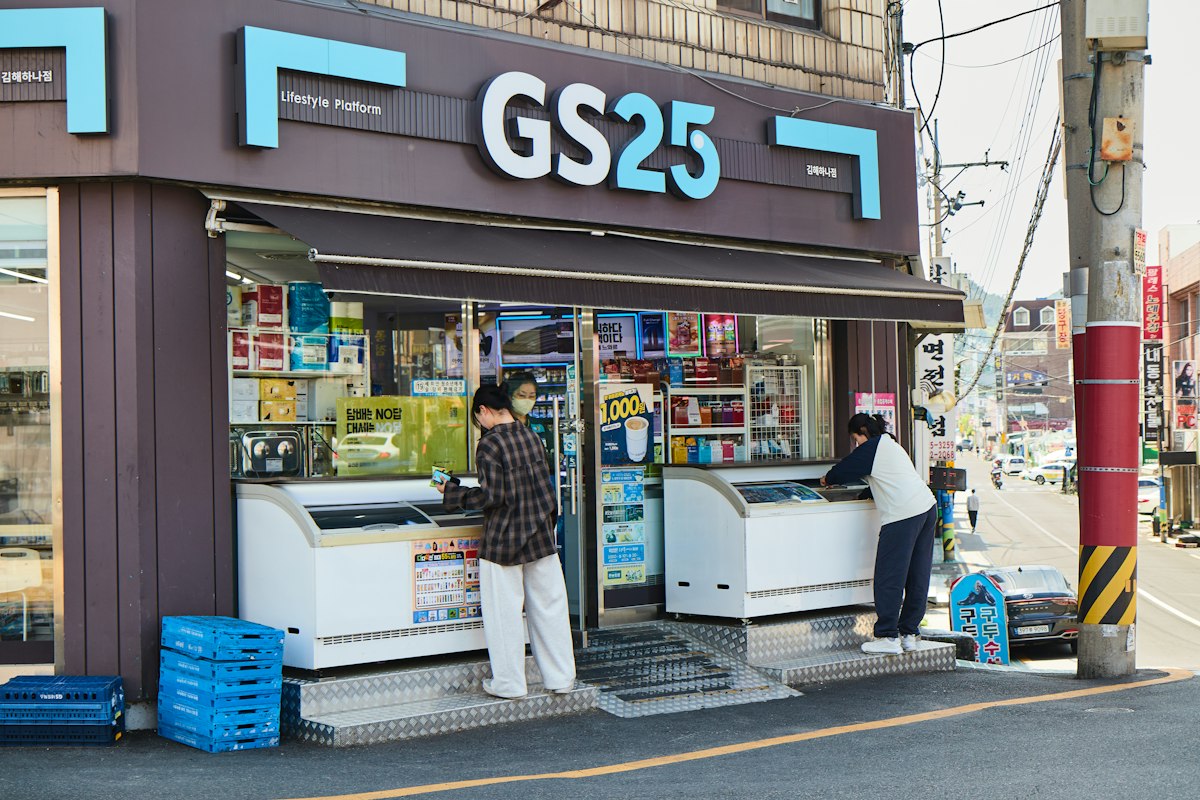
Customers at the open freezers of a GS25 convenience store in Korea — this guide focuses on wowpass vs namane card: which pre-paid tourist card is best for south korea?. Photo via Unsplash.
Living in Seoul as an expat for over six years, I have greeted dozens of visiting friends and family at Incheon International Airport. Inevitably, within thirty minutes of clearing customs at Terminal 1 or Terminal 2, the exact same question comes up while standing near the Airport Railroad Express (AREX) gates: “Should I get a WOWPASS or a NAMANE card?”
South Korea is one of the most technologically advanced and cashless societies in the world. Street-food vendors in Myeongdong, hole-in-the-wall kimbap diners in Hongdae, and trendy boutiques in Seongsu-dong all run primarily on plastic or mobile tap. However, foreign credit cards still run into occasional hiccups with local payment gateways, and navigating local subway turnstiles requires a dedicated transit chip. That is where tourist-dedicated prepaid cards step in. In this comprehensive guide, I will break down the features, real costs, transit compatibility, and hidden quirks of both WOWPASS and NAMANE so you can confidently pick the right card for your trip.
Quick Summary: Which Card Wins?
Choose WOWPASS if: You are arriving with physical foreign cash (USD, JPY, EUR, TWD, HKD, SGD, etc.) and want a seamless, all-in-one currency exchange kiosk experience that loads directly onto a chip card with integrated T-money transit convenience. It is the hassle-free gold standard for first-time visitors seeking competitive exchange rates without bank queues.
Choose NAMANE if: You prefer topping up via credit card or digital wallets directly on your smartphone, love the idea of designing a personalized keepsake card printed with your favorite K-pop idol or travel photo, and want the freedom to transfer balances between shopping and transit on the fly using mobile NFC.
Understanding WOWPASS: The Currency Exchange Powerhouse
Launched specifically to eliminate currency exchange friction for international tourists, WOWPASS operates as a prepaid debit card backed by a nationwide network of multi-currency automated kiosks. You will spot these bright orange machines at Incheon Airport (T1 and T2 AREX concourses), major subway stations across Seoul (like Myeongdong, Hongdae, Gangnam, and Seoul Station), as well as prominent tourist hotels.
The standout feature of WOWPASS is its physical kiosk exchange engine. You simply insert your foreign cash bills—supporting 16 major currencies—and the kiosk converts your money at remarkably competitive exchange rates directly onto your card’s Korean Won (KRW) balance. There is no need to wander through Namdaemun searching for private currency exchange booths or paying high foreign transaction fees at airport bank counters.
In addition to retail shopping, WOWPASS includes an embedded T-money chip, the universal transit card used across Korea’s subways, city buses, and taxis. However, there is a crucial technical distinction that every traveler must understand: WOWPASS maintains two completely separate balances on a single piece of plastic. Your primary shopping balance is held on the IC debit chip, while your transit balance lives on the contactless T-money chip. While recent app updates allow you to transfer funds between balances using NFC-enabled smartphones, the traditional method requires loading physical KRW cash onto the T-money balance at subway ticket vending machines or convenience stores.
Understanding NAMANE: The Customizable Digital Favorite
NAMANE (derived from the Korean phrase meaning “My Own”) approaches travel payments from a creative, mobile-centric perspective. Rather than focusing on cash exchange kiosks, NAMANE is famous for its customizable photo front. Before arriving in Korea, you can download the NAMANE app, upload any high-resolution image—such as a selfie at Gyeongbokgung, a picture of your pet, or a photo of your favorite BTS or NewJeans bias—and generate a custom QR code.
When you arrive in Korea, you scan that QR code at any NAMANE kiosk (found at Incheon Airport, CU convenience stores, and key subway hubs), and the kiosk physically prints your custom design onto the front of a blank smart card in less than a minute. It turns an ordinary travel utility into a cherished souvenir.
Functionally, NAMANE is also a dual-balance card, split into a Pay Balance (for shopping, dining, cafes, and convenience stores) and a Transit Balance (running on the Rail+ rail and transit network). Where NAMANE truly outshines the competition is its mobile agility. By tapping the physical card against the back of your smartphone using the NAMANE app’s NFC feature, you can instantly move funds between your Pay Balance and your Transit Balance whenever you want, without needing cash or a physical top-up machine.
Head-to-Head Comparison: WOWPASS vs NAMANE
To help you see how these two cards stack up side by side, here is a detailed breakdown of their key specifications, costs, and capabilities:
Feature
WOWPASS Card
NAMANE Card
Card Issuance Fee
5,000 KRW (non-refundable)
7,000 KRW (custom photo print)
Primary Top-Up Method
16 foreign cash currencies at automated kiosks
International cards (Visa/Mastercard), digital pay, or KRW cash
Card Personalization
Standard branded card face
100% custom photo print via kiosk
Transit Network
T-money (Subways, buses, taxis nationwide)
Rail+ (Subways, buses, KTX, ITX, Korail lines)
Balance Transfer
Available via app NFC (or manual cash top-up)
Instant in-app transfer between Pay and Transit
ATM / Cash Withdrawal
KRW cash withdrawal available at WOWPASS kiosks (1,000 KRW fee)
Withdrawals possible via app refund to bank or at specific counters
Kiosk Locations
160+ kiosks across major subway lines, airports, hotels
Over 100 kiosks at Incheon Airport, CU stores, rail stations
The Transit Breakdown: T-Money vs Rail+
One of the most common points of confusion for tourists in Seoul is the transit system partnership. While both cards allow you to tap into the Seoul Metro, board city buses, and hail taxis across South Korea, they operate on different underlying transit protocols.
WOWPASS utilizes T-money, which is the historical undisputed king of Korean transit. T-money works seamlessly in Seoul, Busan, Jeju, Daegu, Gwangju, and virtually every regional county. You can top up your T-money balance with cash at any subway ticket machine in the country, or at any 7-Eleven, GS25, CU, or Emart24 convenience store.
NAMANE utilizes Rail+, a transit standard developed by Korail (the national railway operator). Rail+ works across all metropolitan subway lines, city buses, and nationwide highway toll booths, just like T-money. Because it is powered by Korail, it also works seamlessly for purchasing tickets at Korail train counters (including KTX high-speed trains and regional ITX lines). However, if you ever find yourself needing an emergency physical cash top-up for your Rail+ transit balance outside the app, you will need to do it at Korail station kiosks or participating convenience store chains like CU and StoryWay, as some regional subway vending machines only accept T-money.
Fees, Top-Up Costs, and Currency Exchange Reality
When choosing between these cards, your payment habits directly dictate your expenses:
If you bring physical cash: WOWPASS is unbeatable. Converting crisp USD, Euro, or Yen banknotes directly into card-ready KRW at a WOWPASS kiosk incurs zero additional exchange service charges beyond the competitive built-in spread. By contrast, loading physical cash onto NAMANE requires you to first convert your foreign cash into Korean Won notes elsewhere, adding an unnecessary errand to your itinerary.
If you prefer charging by credit card: NAMANE offers convenience, but it comes at a price. When you load your NAMANE Pay Balance using an international credit card (Visa, Mastercard, or JCB) within the NAMANE app, you will face an in-app payment processing surcharge (typically 3% to 6%). When combined with whatever foreign transaction fee your home bank charges, reloading frequently can quietly eat into your Korean barbecue budget. WOWPASS also allows credit card top-ups via their mobile app, but foreign card fees similarly apply, making cash kiosk conversion their primary value driver.
Seoul Expat Pro Tips: Avoid the Beginner Mistakes
Over the years, I have seen travelers run into the same small snags. Keep these four hard-earned insider tips in mind before tapping your card:
Skip the Incheon Terminal 1 Kiosk Line: The WOWPASS and NAMANE machines right outside the AREX express train gates at Incheon Airport frequently develop massive queues when international flights land. If the line is twenty people deep, do not waste your vacation waiting. You can buy a standard single-journey transit ticket into the city, check into your hotel, and comfortably issue your card at a completely empty kiosk inside Myeongdong, Hongdae, or Dongdaemun stations.
Keep 20,000 KRW in Physical Cash Handy: While 95% of Seoul is cashless, transit top-up machines inside subway stations still strictly require physical Korean paper banknotes. Even if you hold a card with 300,000 KRW on the shopping balance, your card will be rejected at the subway turnstile if your transit balance reads zero. Keep a couple of 10,000 KRW bills in your wallet just in case.
Activate Card Lock Features in the App: Both the WOWPASS and NAMANE apps allow you to instantly freeze and unfreeze your card with a single toggle. If you misplace your card while shopping at Olive Young or riding a crowded bus, open the app immediately and lock it. If you locate it in your backpack later, you can unlock it instantly without canceling the card.
Plan Your Refund Strategy Before Departing: Do not leave 100,000 KRW trapped on your card when heading home. WOWPASS allows you to withdraw remaining KRW cash directly at their airport kiosks for a nominal 1,000 KRW fee. For NAMANE, balance refunds can be requested through the app, but processing times can take a few business days depending on your bank.
Frequently Asked Questions
Can I use WOWPASS or NAMANE to ride the AREX Express Train and KTX?
Yes, but with different mechanics. For the AREX All-Stop train (the local subway line connecting Incheon Airport to Seoul Station), you simply tap either card at the turnstile using your transit balance. However, for the AREX Non-Stop Express Train or national KTX bullet trains, seating is strictly reserved. You cannot tap at a turnstile to board; instead, you must purchase a designated ticket at the automated ticket machine or ticket counter using your card’s retail payment balance.
Can I just rely on Apple Pay or Google Pay instead of these cards?
While Apple Pay is slowly expanding across South Korea (accepted at modern convenience stores, department stores, and major international franchises like Starbucks and McDonald’s), it is still not supported on Korea’s public transit network (subways and buses). Google Pay remains virtually unsupported at domestic offline payment terminals. A physical smart card—whether WOWPASS, NAMANE, or an ordinary T-money card—remains mandatory for stress-free transit across Korea.
What should I do with my leftover transit balance when leaving Korea?
Because the transit balance lives on a separate chip from your shopping balance, kiosk cash withdrawals from WOWPASS only pull from your shopping balance. If you have remaining money on your T-money transit chip, step into any convenience store (CU, GS25, 7-Eleven) at Incheon Airport before security, hand the clerk your card, and say “Hwan-bul hae-ju-se-yo” (Please refund). They will pay you back your remaining transit balance in Korean cash on the spot (minus a small 500 KRW service fee).
Ultimately, both cards deliver fantastic convenience for navigating Korea’s high-tech retail landscape. If you are packing foreign currency and want an all-in-one payment and exchange powerhouse, get a WOWPASS. If you want a fun, customizable souvenir that lets you manage balances on your phone, NAMANE is a brilliant companion. Enjoy your adventures in Seoul!
Crowded Seoul shopping street at night with a street food cart — this guide focuses on wowpass vs namane card: which pre-paid tourist card is best for south korea?. Photo via Unsplash.