
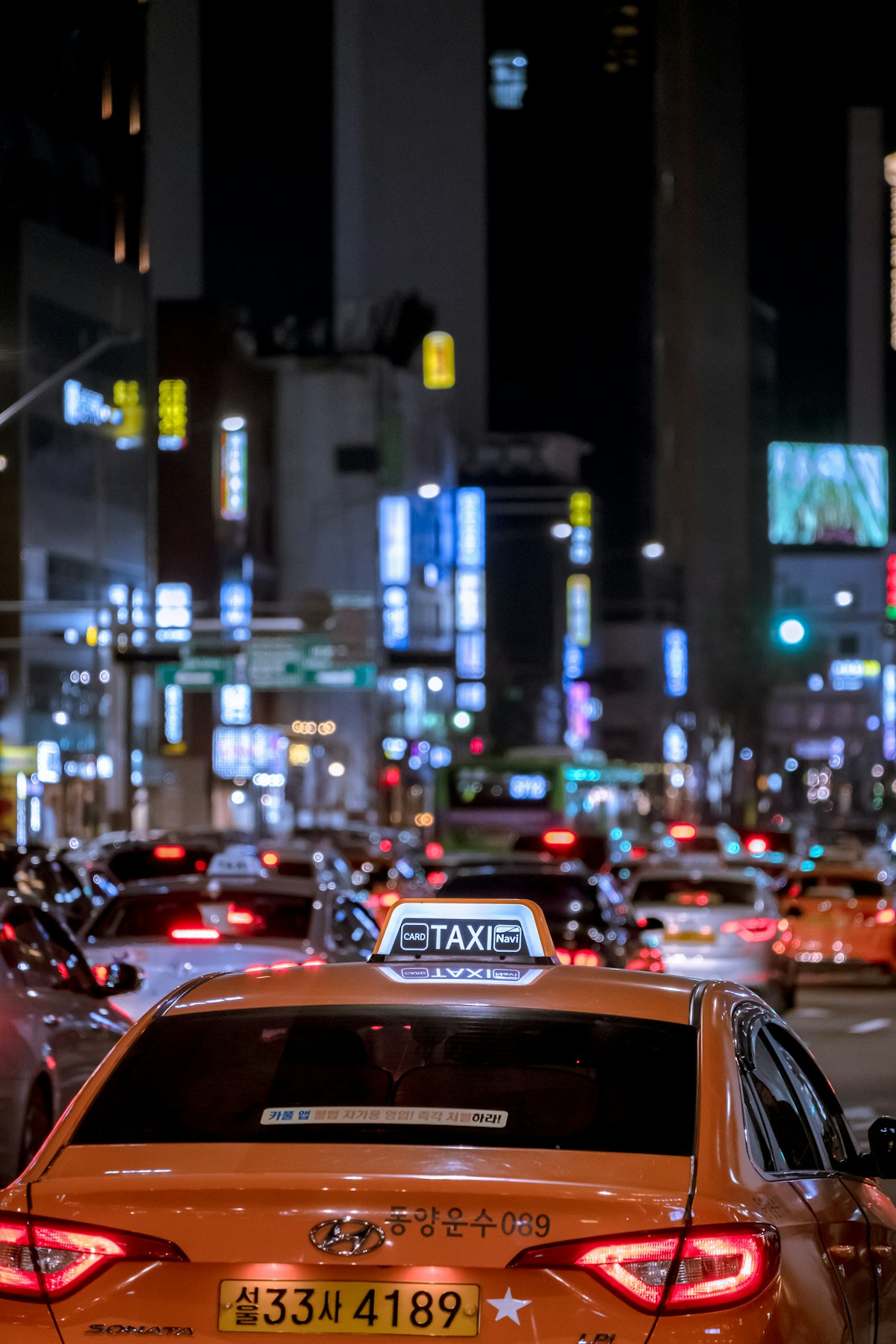

After five years of living in Seoul, I still consider this city’s public transit system to be an absolute marvel. It is clean, incredibly cheap, and runs like clockwork. But even after half a decade of navigating these neon-drenched streets, there is one stomach-dropping moment that still occasionally catches me off guard: that sudden realization that it is past midnight, and the last subway train of the night has already rumbled away without me.
I will never forget my first winter here back in 2019. I had just finished a glorious, late-night feast of spicy rice cakes (tteokbokki) and crispy fried chicken in a cozy tent bar in Sinchon. Brimming with warmth and draft beer, I strolled down to the subway station at 12:15 AM, only to find the heavy steel shutters halfway closed and a security guard waving me away with a polite but firm “kkeut-nasseoyo” (it’s finished). I stood in the freezing, sub-zero wind, watching empty orange Seoul taxis with their lit roof signs speed past in the night traffic, completely clueless about how to flag one down or where to go. Don’t let that be you. Getting home after-hours in Seoul is actually incredibly easy once you know the local rules of the road. Here is my battle-tested, expat-approved guide to mastering Seoul’s night transport.
- Subway Curfew: Most lines stop running between 12:00 AM and 1:00 AM on weekdays, and even earlier on weekends.
- The Owl Bus (N-Bus): The ultimate budget savior. Runs from 11:30 PM to 6:00 AM for just 2,500 KRW.
- Kakao T: The essential Korean ride-hailing app. Crucial for securing rides in high-demand nightlife districts.
- Taxi Surcharges: Midnight surcharges range from 20% to 40% between 10:00 PM and 4:00 AM, so plan your budget accordingly.
Understanding the Dreaded Subway Curfew

One of the most common mistakes international tourists make is assuming that a metropolitan giant like Seoul operates its subways 24/7. It does not. While the city feels like it never sleeps, the trains definitely do. Generally, the last trains depart their origin stations around midnight and wrap up their final runs by 1:00 AM on weekdays. On weekends and public holidays, this curfew is often pushed earlier, with trains wrapping up closer to midnight.
Keep a very close eye on the time if you are drinking in Hongdae, Itaewon, or Gangnam. If you are transferring between lines, your window is even smaller; transfer connections usually stop working around 11:30 PM. My golden rule is simple: if you aren’t on the platform by 11:45 PM, start prepping your backup plan.
Option 1: The Savior “Owl Bus” (All-Night Bus)
If you are on a budget, your absolute best friend is the Seoul Owl Bus (올빼미버스). You can easily identify these night owls by the letter “N” preceding the route number on the front of the bus (for example, N13, N26, or N61). These routes were specifically designed by analyzing late-night mobile data to connect Seoul’s busiest nightlife hubs with residential neighborhoods.
Watching the light trails from these buses and cars across a busy Seoul intersection at night is a classic city view, and riding one is a true local experience. They run from roughly 11:30 PM to 6:00 AM, with intervals ranging from 15 to 35 minutes depending on the route. The fare is flat at 2,500 KRW (approx. $1.85 USD) when using a T-money transit card, which is a massive steal compared to a late-night taxi fare.
Essential Owl Bus Routes to Remember:
- N13: Connects northern Seoul (Dobong-san) to southern Seoul (Songpa), passing through Dongdaemun, Yaksu, and the heart of Gangnam.
- N26: The ultimate nightlife connector. It runs from Gimpo in the west to Jungnang in the east, directly linking Hongdae, Sinchon, Jongno, and Dongdaemun.
- N61: Perfect if you need to travel between southwestern Seoul (Guro) and southeastern Seoul (Nowon), cutting straight through Yeouido and Gangnam.
My Expat Advice: Download the KakaoMap or Naver Map app. Google Maps is notoriously unreliable for real-time transit data in South Korea due to national security mapping restrictions. KakaoMap will show you exactly when the next N-bus is arriving, down to the second.
Option 2: Hailing a Taxi on the Street
When the weather is freezing or you are simply too exhausted to figure out bus stops, a taxi is the most convenient option. In Seoul, standard taxis are typically bright orange, silver, or white. At night, you will spot them cruise by with their iconic lit roof signs navigating the neon traffic.
To hail a taxi on the street, you need to look at the windshield on the passenger side. You will see a small LED light. Here is the secret code:
- Red Light glowing “빈차” (Bin-cha): This means “Empty Car.” Stick your hand out confidently to wave them down!
- Blue Light glowing “예약” (Ye-yak): This means “Reserved.” The driver is on their way to pick up someone who booked via an app. Do not bother waving; they will not stop.
- No Light: The taxi is occupied.
Be prepared for the late-night surcharge (할증 – haljeung). The standard base fare starts at 4,800 KRW (approx. $3.50 USD), but between 10:00 PM and 4:00 AM, a dynamic surcharge of 20% to 40% is automatically applied to the meter. The peak surcharge hits between 11:00 PM and 2:00 AM, so a ride that usually costs 15,000 KRW during the day can easily climb past 22,000 KRW at night.
Option 3: Kakao T (The Essential App)
If you are trying to catch a taxi on the street in a busy area like Itaewon at 1:30 AM on a Friday, you are going to face fierce competition. This is where Kakao T comes in. It is South Korea’s equivalent of Uber, and it is absolute magic.
I remember my first time using Kakao T. I was trying to leave a lively barbecue dinner in Mapo. I downloaded the app, but as a tourist, I didn’t have a local Korean credit card, which the app initially insisted on for automatic payments. I panicked, thinking I was locked out of the service. Then, a friend showed me the ultimate workaround: when booking a standard taxi, scroll past the automatic payment options and select “Pay directly to driver” (현장결제). This allows you to book the ride through the app and simply hand your physical credit card or T-money card to the driver when you reach your destination. It saved my night, and it will save yours too.
How to Use Kakao T as a Tourist:
- Download the app (it has a full English interface).
- Verify your account using your international phone number.
- Set your pickup point and destination (you can type in English, but typing the Korean address is always more accurate).
- Select “General Taxi” and swipe left on the payment options to choose “Pay to Driver.”
- Click “Request” and wait for a driver to accept. You will see their license plate and real-time location.
Seoul Late-Night Transport Comparison
To help you decide which option fits your current situation, here is a quick breakdown of how the different nighttime transit methods compare:
| Transit Type | Cost (KRW) | Availability | Best For |
|---|---|---|---|
| Owl Bus (N-Bus) | 2,500 KRW | 11:30 PM – 6:00 AM (15-35 min intervals) | Solo travelers, budget-conscious tourists, predictable routes. |
| Street-Hailed Taxi | Base 4,800 KRW + Surcharges | 24/7 (Harder to find in busy nightlife districts) | Quick trips from quieter residential areas; spontaneous rides. |
| Kakao T (General) | Base 4,800 KRW + Surcharges | 24/7 (High matching rate via app) | Getting home from crowded areas like Itaewon or Hongdae. |
| Kakao T (Venti / Black) | Varies (Much higher premium pricing) | 24/7 (Instant matching even at peak times) | Groups with heavy luggage, or when regular taxis are completely booked. |
Pro Tips for Tourists
- Avoid the Flat-Rate Scam: If a taxi driver parks near a major clubbing district like Itaewon or Hongdae, refuses to turn on the meter, and quotes you a flat rate (e.g., “50,000 KRW to Myeongdong”), do not get in. This is highly illegal in Korea. Legitimate drivers must use the meter. Simply walk away and call a Kakao T.
- Have Your Address in Korean: Many older taxi drivers do not speak English or read the Romanized alphabet. Always have your hotel’s name and address written in Korean Hangul on your phone. You can easily copy this from your booking confirmation or Naver Map.
- Keep Your T-Money Card Charged: If you plan on taking the Owl Bus, make sure your T-money card has at least 5,000 KRW loaded on it before midnight. Most convenience stores can top it up, but finding an open one or a subway station card charger in the middle of the night can be a hassle.
- Check for Leftovers: If you accidentally leave your phone or wallet in a taxi, your receipt is your lifesaver. If you paid by credit card or T-money, the customer service line can trace the vehicle. If you used Kakao T, you can easily call your driver back directly through the app history.
Frequently Asked Questions
What should I do if a taxi driver refuses to take me?
While rare, some drivers might refuse passengers if the destination is too close or in the opposite direction of their garage at shift-end. This is illegal. If this happens, do not argue. Take a photo of the license plate or the driver’s ID on the dashboard and report it to the Seoul Global Center or call 120 (Seoul’s tourist helpline). To avoid this entirely, use the Kakao T app, where the destination is locked in beforehand.
Does Uber work in Seoul?
Yes, Uber works in Seoul, but it operates through a joint venture called UT (Uber Taxi). The app interface looks exactly like your home Uber app and will call standard licensed Korean taxis. While it works well and allows you to use your registered international credit card directly, Kakao T still has a significantly larger pool of active drivers, making Kakao T much faster for late-night hailing.
Can I pay for a late-night taxi using my international credit card?
Yes! Almost 100% of Seoul taxis are equipped with credit card terminals. Visa, Mastercard, and American Express are widely accepted. You can also pay using your T-money transit card. Simply tap your card on the terminal located between the driver and passenger seats at the end of your ride. Cash is also accepted, but card payments are preferred and much faster.